
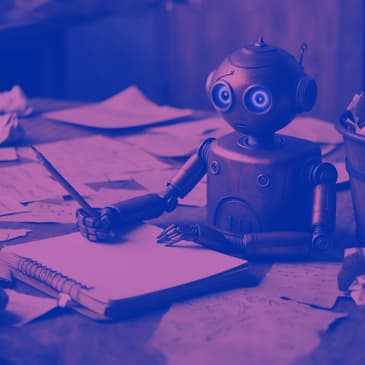
An Australian study has proven what we probably knew all along: AI isn’t as good at writing titles and descriptions as the techbros think it is.
.
.
📰 Get our free daily newsletter
📈 Advertising: Reach Thousands of Marketing Decision-Makers
🌍 Follow us on social media or contact us
.
Get these exclusive benefits when you upgrade:
✅ Listen ad-free
✅ Back catalog of 20+ marketing science interviews
✅ Get the show earlier than the free version
✅ “Skip to story” audio chapters
✅ Member-only monthly livestreams with Tod
And a lot more! Check it out: todayindigital.com/premium
✨ Premium tools: Update Credit Card • Cancel
.
MORE
🆘 Need help with your social media? Check us out: engageQ digital
.
UPGRADE YOUR SKILLS
Google Ads for Beginners with Jyll Saskin Gales
Inside Google Ads: Advanced with Jyll Saskin Gales
Foxwell Slack Group and Courses
.
Today in Digital Marketing is hosted by Tod Maffin and produced by engageQ digital on the traditional territories of the Snuneymuxw First Nation on Vancouver Island, Canada. Associate producer: Steph Gunn.
Some links in these show notes may provide affiliate revenue to us.
Privacy & Opt-Out: https://redcircle.com/privacy
[00:00:01] It's Tuesday, October 15th. Today, AI wrote this episode's title and its terrible. Also,
[00:00:08] Reddit upvotes keyword targeting, a new Google Ads optimization targets gross profit,
[00:00:14] and the top Halloween trends are out for you to exploit. I'm Steph Gunn sitting in for Todd
[00:00:20] Maffin. That's ahead today in Digital Marketing. AI may be good at many things, but title writing,
[00:00:27] not so much. New research suggests you may want to reconsider turning to AI for your next product
[00:00:33] title, podcast title, or email marketing heading. The Australian Broadcasting Corporation recently
[00:00:39] ran an experiment using Microsoft's CoPilot AI to create podcast titles, which can offer insights
[00:00:45] for marketing beyond podcasting, especially for crafting product or blog post titles.
[00:00:50] The results? CoPilot's attempts at generating titles and descriptions fell short,
[00:00:55] missing the mark on creativity, tone, and editorial judgment. While AI occasionally produced a usable
[00:01:01] title, the ABC said the results often felt generic, corny, or overly simplistic. Researchers described
[00:01:08] the suggestions as sappy and cringe, describing the process as prompt roulette. The prompt tried to
[00:01:15] coax various approaches from CoPilot to provide creative inspiration for podcast producers. However,
[00:01:20] most of the suggestions ended up being strikingly similar in wording, style, and format. A major
[00:01:26] frustration was AI's obsession with punctuation, particularly colons. Despite clear prompts to
[00:01:33] avoid them, they couldn't stop the number of suggested titles with colons in them. In the end,
[00:01:39] the researchers said the process was slower and less effective than if they had written the titles and
[00:01:43] descriptions themselves. Quoting the Australian Broadcast Corporation,
[00:01:47] The downside and somewhat encouraging learning from this experiment has been that AI doesn't seem to be
[00:01:54] better than humans at headline writing. While it occasionally comes up with a usable,
[00:01:59] if uninspired headline, it's a long way from what we humans can come up with. End quote.
[00:02:09] Considering hopping on the influencer marketing bandwagon, you're not alone. A new report from
[00:02:15] CreatorIQ has found that three out of four brands are increasing their creator marketing spend this
[00:02:20] year. After a dip in investments last year, companies are once again looking for creators to boost their
[00:02:26] promotions. The report notes that those investing $1 million or more annually are seeing the highest
[00:02:32] returns on investment through these partnerships. However, many brands still grapple with measurement
[00:02:37] challenges. When it comes to strategies, sponsored content remains the most effective approach for
[00:02:43] brands. Instagram continues to dominate as the top platform for brands using influencers, followed by
[00:02:49] TikTok and YouTube. TikTok, however, has overtaken Instagram as the most frequently used platform by
[00:02:56] creators. The report also highlights the growing influence of generative AI and creative marketing,
[00:03:03] with nearly half of brands using AI to generate short-form content.
[00:03:11] Reddit has some updates to its keyword ad targeting options. The platform launched contextual keyword
[00:03:17] targeting last year, which lets advertisers display their ads based on the context of each conversation,
[00:03:23] not just the subreddit community. Now, Reddit is making keyword targeting available in more places.
[00:03:29] The latest update includes multi-placement optimization, expanding keyword targeting to more ad
[00:03:36] placements, including feed ads and conversations. Reddit is also rolling out new dynamic audience
[00:03:42] expansion. This works in conjunction with keyword targeting to identify users that are likely to
[00:03:48] engage based on campaign specifics, including ad creative and user behavior. The platform is also adding
[00:03:55] keyword suggestions. Finally, Reddit has also revamped its campaign management interface. They say it will
[00:04:02] simplify the process for advertisers. TikTok is taking ad measurement a step further by tracking how clicks
[00:04:13] convert into foot traffic. The platform this week announced a new partnership with location data company
[00:04:19] InMarket that measures the impact of ads on in-store visits. Here's how it works. InMarket's conversion
[00:04:26] tracking uses a range of touch points to assess in-store traffic. A store visit conversion is recorded when a
[00:04:33] consumer visits a physical store location after being exposed to a TikTok ad. This lets advertisers
[00:04:40] determine if their campaign leads to increased visits post-exposure by comparing the visitation rates of
[00:04:46] users exposed to the ad with those of a similar control group. Essentially, it offers conversion
[00:04:51] lift reporting, but through more precise third-party verified data. While TikTok ramps up ad measurement,
[00:05:01] Google is slowly rolling out a new campaign setting called gross profit optimization, which lets you
[00:05:06] optimize campaigns for actual profit instead of just revenue or return on ad spent. It calculates the
[00:05:13] profit by applying the margins you set up in the optimization goal to the value of each conversion.
[00:05:18] To set up gross profit optimization, you need to provide the following data to Google Ads.
[00:05:24] Cart data and cost of goods sold in your product feed, and set your optimization goal to profit target
[00:05:29] return on advertising spend. The update is currently available in a handful of Google Ads accounts for now.
[00:05:39] Need some inspo for your Halloween marketing campaign? Google recently launched the latest version
[00:05:45] of its Fright Geist Halloween Search Trends mini-site, including everything from spooky makeup searches to
[00:05:51] food trends, Halloween decor, and even dog costumes. This year's lineup also includes the top costume
[00:05:58] trends based on U.S. search activity. The top three costumes include number one coming in at
[00:06:04] Shrunken Head Bob, the Beetlejuice Shrunken Head is the most searched shrunken head of all time.
[00:06:10] Number two comes in at Raygun, the Australian Olympic breakdancer who didn't exactly bring home the gold.
[00:06:17] And finally, number three is Catnap, which I actually had to Google myself because I had
[00:06:21] absolutely no idea who this character was, but it's a character from The Smiling Critters,
[00:06:26] which is a line of colorful plush animals that possess big mouths and very unsettling black eyes.
[00:06:35] So some big news for me, it's actually my three-year anniversary of working as the associate
[00:06:41] producer for the podcast. You know, I did cheat a little bit because I've been on that leave only
[00:06:46] for the past year, but you know, here's to three years of podcasting. Well, more like two years and
[00:06:53] one year of getting bossed around by a tiny infant. Thanks for listening. I'm Steph Gunn. Todd is back tomorrow.