
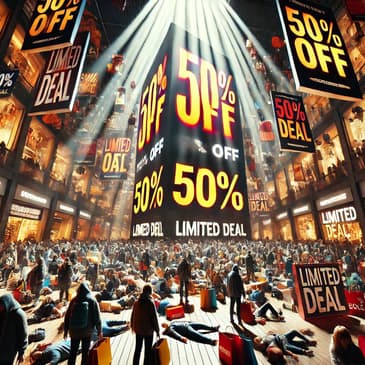
Marketers ruined Black Friday; here's how we can fix it. Why is an entire category of TikTok Ads at Risk? Google is now Hiding a metric they've had since day one, a massive Meta Bug Disrupts Financial Services Ads, and you'll never guess how much content on LinkedIn is AI spam these days. )(Naw, you'll probably guess.)
.
📰 Get our free daily newsletter
🌍 Follow us on social media or contact us
📈 Advertising: Reach Thousands of Marketing Decision-Makers
.
Get these exclusive benefits when you upgrade:
✅ Listen ad-free
✅ Back catalog of 20+ marketing science interviews
✅ Get the show earlier than the free version
✅ Member-only monthly livestreams with Tod
And a lot more! Check it out: todayindigital.com/premium
✨ Premium tools: Update Credit Card • Cancel
.
MORE
🆘 Need help with your social media? Check us out: engageQ digital
.
UPGRADE YOUR SKILLS
Google Ads for Beginners with Jyll Saskin Gales
Inside Google Ads: Advanced with Jyll Saskin Gales
Foxwell Slack Group and Courses
.
Today in Digital Marketing is hosted by Tod Maffin and produced by engageQ digital on the traditional territories of the Snuneymuxw First Nation on Vancouver Island, Canada. Associate producer: Steph Gunn.
Some links in these show notes may provide affiliate revenue to us.
Privacy & Opt-Out: https://redcircle.com/privacy
[00:00:00] It is Black Friday, November 29th. This week, why an entire category of TikTok ads is at risk. Google is now hiding a metric they've had since day one. A massive meta bug disrupts financial services ads. And you will never guess how much content on LinkedIn is AI spam these days. Now you'll probably guess.
[00:00:23] I'm Todd Maffin. That's ahead on our new Friday wrap up show. And just briefly, in case you missed it and were wondering where the show was this week, we have revamped the podcast and the newsletter. You will still get all the digital marketing news right here on the show, but we'll be doing it in a single weekly wrap up episode on Fridays.
[00:00:42] Part of that is because you've told us the daily episodes are sometimes hard to fit into your week. And part of it also is the state of the podcast ad market. Listen to last Friday's episode if you'd like all the gory details on that.
[00:00:54] So the podcast will be twice a week. Fridays is this show with a couple of big stories with deeper analysis than we've been able to do before. And then a complete wrap up of the week's events in digital marketing.
[00:01:06] Tuesdays will be deep dive episodes with columnists, marketing scientists, experts and more. That Tuesday show will kick off in a few weeks. And if you really miss the daily updates, we're still doing that on our newsletter, which you can sign up to for free at today in digital dot com slash newsletter.
[00:01:22] OK, on with the show. It is Black Friday today. And for many that day used to be filled with excitement, early mornings and great deals at stores.
[00:01:36] But now shoppers say it's lost its magic and it's probably our fault. Fellow marketers.
[00:01:43] Take 76 year old Max Fraser quoted in a great think piece this morning in The New York Times.
[00:01:47] He and his wife used to spend Thanksgiving evening flipping through newspaper ads to find the best deals on toys for their grandchildren.
[00:01:53] They'd wake up super early, stand in line outside stores at 430 a.m., eagerly discussing their shopping plans.
[00:01:59] Now, Max says he hasn't shopped on Black Friday in at least five years.
[00:02:05] When The New York Times asked readers about their Black Friday plans, more than 75 people responded.
[00:02:10] Most said they weren't planning to shop that day, partly because of the sales which now start early and continue into the new year.
[00:02:18] Liz Jarvis used to love Black Friday.
[00:02:20] When stores opened, the staff would hand out coupons or prizes and make the day feel special.
[00:02:25] And yes, fun.
[00:02:27] But something began to shift.
[00:02:29] Stores started opening earlier.
[00:02:31] Shoppers began arriving bleary eyed in the middle of the night.
[00:02:34] She said, quote,
[00:02:51] This is, of course, our fault.
[00:02:54] We discovered that a surprise day before sale worked well, so we extended it back.
[00:02:59] And then back a few more days.
[00:03:01] Then we invented Black Friday week.
[00:03:03] And with the online ad market so competitive, along with its benefits of knowing what the cost of each sale was,
[00:03:09] it's really no surprise the days evolved into the loud and increasingly underwhelming day or week or month that it has.
[00:03:17] So how do we fix things?
[00:03:18] For one, we should think about making the day literally today, the Friday, an exciting day again.
[00:03:25] The one day customers look forward to.
[00:03:28] By watering it down and extending it by days and weeks, it loses the feeling of magic and delight.
[00:03:33] That doesn't mean we have to stay silent.
[00:03:35] By all means, hype up the day in email marketing and on your site.
[00:03:39] You could even hint at what your offer will be.
[00:03:41] But leave the special day for the special day.
[00:03:44] The other thing I've noticed is that the deals themselves have become less exciting.
[00:03:49] I was playing around with an AI song generator yesterday, and it was hyping it's 40% off for Black Friday deal.
[00:03:55] I thought 40% off is a pretty good deal, so I went for it.
[00:03:59] It was only when I was on the credit card screen that I noticed the deal was actually 40% off for the first month only.
[00:04:06] And then the full price after that.
[00:04:08] That means if I were to sign up for a year, my actual discount would be less than 3.5%.
[00:04:15] That's not a deal, and it certainly wouldn't excite me as a potential buyer.
[00:04:19] The famed advertising pioneer David Ogilvie once said,
[00:04:23] You can't bore people into buying your product.
[00:04:27] In the pursuit of sales, we've taken what was once a fun day for consumers and turned it into an email box full of offers and web banners promoting less than exciting offers.
[00:04:36] We've made it boring.
[00:04:37] Loud, but boring.
[00:04:40] We also have the potential to change this.
[00:04:42] So next year, consider what would be surprising to your potential customers.
[00:04:46] How will you stand out amidst the sea of sales?
[00:04:49] What will you do differently on Black Friday?
[00:04:52] You have 364 days to figure it out.
[00:04:56] The timer starts now.
[00:05:01] All right, to the week's news, and we start with advertising.
[00:05:04] Google has implemented stricter policies against misleading ad designs,
[00:05:09] specifically targeting ads that imitate system warnings, download buttons,
[00:05:13] or other deceptive interface elements that could confuse users more.
[00:05:17] So review your ad creative inventory to make sure you are in compliance with these new design guidelines.
[00:05:22] Google this week also launched a new conversation-started metric for message assets like WhatsApp,
[00:05:29] measuring how often users start a conversation after clicking a message-based ad.
[00:05:33] That update is now live.
[00:05:36] Meta seems to have fixed a nasty bug that stopped new financial services advertisers in the UK from running campaigns,
[00:05:42] disrupting those campaigns for days.
[00:05:44] The bug lasted from late July to just this week.
[00:05:48] Meta confirmed the issue is resolved, but some advertisers still report issues.
[00:05:52] Always a good idea to keep in mind to have contingency plans in place for critical campaigns
[00:05:56] to address unexpected platform issues.
[00:06:00] Make sure you can switch to another platform if you need to.
[00:06:02] TikTok's Smart Plus tool, which lets AI optimize creative and target ads,
[00:06:07] has yielded mixed results after nearly two months of testing,
[00:06:11] compared to Meta's Advantage Plus shopping campaigns.
[00:06:14] While some D2C brands saw a 10% boost in conversions,
[00:06:18] others flagged inconsistent performance and even pulled their campaigns.
[00:06:22] Advertisers have reported that the lack of detailed revenue data,
[00:06:25] beyond basic metrics like impressions and conversions,
[00:06:28] has made it difficult to assess the tool's true effectiveness.
[00:06:32] And Snapchat's new inbox DM ads called Sponsored Snaps
[00:06:36] are taking over users' inboxes with the first three slots now filled by promotions instead of DMs.
[00:06:43] These include ads for Snapchat Plus, Snap's AI chatbot,
[00:06:48] and a Mona 2 promotion through Disney.
[00:06:50] With nine slots displayed in total,
[00:06:53] a third of the inbox is now dedicated to Snap's own promotions and features.
[00:07:00] All right, turning to the week's SEO news,
[00:07:02] Google has confirmed that it is intentionally hiding the total number of search results for queries,
[00:07:08] saying the previous count was often inaccurate and misleading to users,
[00:07:12] even though exact counts still appear for site-specific searches.
[00:07:16] Also, new data reveals that significant changes in Google search click-through rates
[00:07:20] across industries during Q3 are happening.
[00:07:22] Informational queries, those are with words like what, when, and how,
[00:07:27] gained 1.6% on mobile.
[00:07:29] Commercial queries, though, declined across devices,
[00:07:32] with mobile dropping 3.5% more.
[00:07:35] Google search is experiencing renewed volatility,
[00:07:38] just as the November 2024 core update nears completion.
[00:07:41] The update, which started rolling out a couple of weeks ago,
[00:07:43] saw moderate changes initially,
[00:07:45] followed by a quieter second week,
[00:07:47] but now significant ranking fluctuations have returned.
[00:07:50] Google is testing changes to comply with the Digital Markets Act in Europe,
[00:07:56] aimed at benefiting small retailers, airlines, and hotel operators.
[00:07:59] The test will remove certain hotel features,
[00:08:02] including maps and property information,
[00:08:04] in favor of showing links to individual websites.
[00:08:08] Google confirmed latency and slowness issues with the Google Ads console earlier this week.
[00:08:13] The issues started at the beginning of the week,
[00:08:15] and most have since been resolved.
[00:08:17] To the world of social media now,
[00:08:19] and Instagram introducing new direct messaging features,
[00:08:22] including live location sharing and custom nicknames for contacts.
[00:08:26] Threads enhanced its improved video viewing options,
[00:08:29] and you'll be able to search now within a specific date range,
[00:08:32] or search for posts from a single account more.
[00:08:35] TikTok is blocking teens from using beauty filters to address mental health concerns.
[00:08:41] New changes will restrict under-18s from using certain appearance-altering effects,
[00:08:46] and expand filter descriptions to clarify exactly what they alter.
[00:08:49] Filters with effects like skin smoothing or altering facial features will require age verification.
[00:08:56] No word yet on how this will affect TikTok ads.
[00:09:00] Instagram is testing a new collage option for stories,
[00:09:03] which lets brands and users select multiple images from their camera roll
[00:09:07] to create a collage image to post to their story.
[00:09:11] YouTube shared some tips this week to help brands align their ads
[00:09:15] with the growing connected TV audience.
[00:09:17] Key tips include tracking TV viewing behaviors through YouTube analytics,
[00:09:21] uploading in 4K,
[00:09:22] and using higher resolution thumbnails than you are probably currently using.
[00:09:26] This week, socialmediatoday.com had a great little list of which platforms penalize or limit links
[00:09:32] to keep users from leaving their platforms.
[00:09:34] Facebook doesn't directly penalize link posts, it says,
[00:09:38] but has reduced their prevalence, favoring content like Reels.
[00:09:42] Instagram doesn't allow links in captions,
[00:09:44] but lets users share them in stories with limited reach to followers.
[00:09:47] Threads says it doesn't limit link reach despite user speculation.
[00:09:52] And X actively reduces the reach of posts with external links.
[00:09:56] Some news from LinkedIn,
[00:09:58] more than 54% of longer English language posts on LinkedIn
[00:10:02] are likely AI generated according to a new analysis.
[00:10:06] The uptick happened when ChatGPT came out.
[00:10:09] LinkedIn claims it has robust defenses to identify low quality and duplicate content,
[00:10:15] but they identify it.
[00:10:18] They don't remove it.
[00:10:19] They just ensure, quote,
[00:10:21] it is not broadly promoted, unquote.
[00:10:24] And finally, a recap of the week's commerce and retail stories.
[00:10:28] TikTok is letting some creators add product links from third-party affiliate networks,
[00:10:33] including Amazon, Walmart, and Target,
[00:10:35] directly to their posts through a new integration.
[00:10:38] Advertisers are increasing investment in Walmart's retail media network
[00:10:42] as it develops distinct offerings and steps out from Amazon's shadow
[00:10:46] with what it says are unique targeting capabilities.
[00:10:49] TikTok's holiday shopping push is back for a second year,
[00:10:52] but the super cheap deals from last time are history.
[00:10:55] TikTok Shop has cut back on funding deep discounts for merchants
[00:10:58] and has tripled its sales fee to 6%,
[00:11:01] so sellers are covering more of the costs.
[00:11:03] Live shopping, though, is a bigger deal,
[00:11:05] with creators hosting long streams from new studios in places like Los Angeles.
[00:11:12] Well, it is that time of the year where I'm trying to figure out holiday gifts.
[00:11:16] Normally, this is a stress for me,
[00:11:17] but this year it's actually kind of fun
[00:11:19] because I am buying a bunch from Uncommon Goods.
[00:11:22] Their catalog is like nothing I've seen before,
[00:11:26] like literally gifts I didn't think were a thing.
[00:11:28] For instance, a jigsaw puzzle of a New York Times front page,
[00:11:32] but you get to pick the date that you want that issue to be,
[00:11:35] like any date since 1851.
[00:11:38] Or a hand-painted custom artwork of where you and your partner had your first date.
[00:11:42] Just send them a photo.
[00:11:43] You'll get a real watercolor framed and ready to hang,
[00:11:47] and a kit that lets you build your own radio.
[00:11:49] Someone get this one for me, please.
[00:11:52] When you shop at Uncommon Goods,
[00:11:53] you are supporting artists and small, independent businesses.
[00:11:58] And with every purchase you make at Uncommon Goods,
[00:12:00] they give back $1 to a non-profit partner of your choice.
[00:12:04] They've donated more than $3 million to date.
[00:12:08] To get 15% off your next gift,
[00:12:10] go to uncommongoods.com slash today.
[00:12:14] That's uncommongoods.com slash today for 15% off.
[00:12:19] Don't miss out on this limited time offer.
[00:12:22] Uncommongoods.com.
[00:12:23] We're all out of the ordinary.
[00:12:26] And finally, remember Wendy's iconic National Roast Day
[00:12:30] where they spent 24 hours playfully roasting anyone brave enough to tweet at them?
[00:12:35] My favorite was the guy that said,
[00:12:37] if beef is never frozen, then how do you guys keep it fresh?
[00:12:39] Wendy's replied in all caps with the word REFRIGERATORS.
[00:12:45] And while your parents might have clutched their pearls
[00:12:47] at a fast food chain making fun of its customers,
[00:12:49] new research suggests Wendy's was onto something.
[00:12:53] A comprehensive study published in the Journal of Consumer Research has found
[00:12:57] that when brands tease their customers in a friendly way,
[00:13:01] it actually makes people more connected to them.
[00:13:03] Think about it like the difference between a friend
[00:13:05] playfully ribbing you versus a stranger being mean.
[00:13:08] One feels bonding, the other just hurts.
[00:13:11] When brands use gentle teasing, consumers start to see them as more human-like and relatable,
[00:13:17] similar to how friends use playful teasing to strengthen their relationships.
[00:13:22] But before every company rushes to roast their customers,
[00:13:25] there's an important catch.
[00:13:26] The teasing has to stay playful and good-natured.
[00:13:30] The study found that when brands cross the line into more aggressive or mean-spirited teasing,
[00:13:35] it completely backfires.
[00:13:37] For example, one Valentine's Day pizza ad saying,
[00:13:41] a cheap date that's almost as cheesy as you are worked well because it's playful.
[00:13:45] But when they tried, a cheesy date that's almost as cheap as you are,
[00:13:50] customers didn't like it.
[00:13:51] Being called cheap feels more like an actual insult.
[00:13:55] The research helps explain why some brands have found major success with teasing.
[00:13:58] When Wendy's launched National Roast Day, they gained 350,000 new Twitter followers in just 24 hours.
[00:14:05] Budget airline Ryanair has built a massive social following through playful jabs at customers.
[00:14:10] And the food delivering app Postmates regularly teases millennials about their ordering habits
[00:14:16] to great engagement.
[00:14:18] So why does it work?
[00:14:20] The study found teasing works because it triggers two key psychological effects.
[00:14:25] First, the human factor.
[00:14:27] Teasing is such a distinctly human behavior that when brands do it,
[00:14:31] we automatically start thinking of them more like people than companies.
[00:14:35] And the surprise element.
[00:14:36] We don't expect companies to tease us.
[00:14:39] So when they do, in a fun way, it catches our attention and makes them more memorable.
[00:14:44] For brands looking to try this strategy, the researchers identified a simple formula.
[00:14:49] Keep the playful elements stronger than the provocative ones.
[00:14:53] It's like adding spice to a food.
[00:14:55] A little heat makes it interesting.
[00:14:56] Too much ruins the dish.
[00:14:58] The study found teasing works best when it focuses on lighthearted topics, uses obvious exaggeration to keep things playful,
[00:15:06] avoids harsh language or strong negative emotions, and stays away from personal characteristics that people might be sensitive about.
[00:15:18] So there it is, our first weekly wrap-up show.
[00:15:21] Remember, you are not missing any of the stories you would have had from the daily shows.
[00:15:25] In fact, you're getting more stories because we are writing them shorter to get you just the information you need.
[00:15:30] We've heard people tell us that they would rather listen for 15 minutes once a week than for 8 to 10 minutes five times a week.
[00:15:36] And in a few weeks, we will be kicking off our Tuesday deep dive episodes as well.
[00:15:41] And by the way, if breaking news happens, like something huge in the marketing world, we will be in your feed regardless of the day with the full story and analysis.
[00:15:50] We are still trying to find our footing with how to present this new format from an acoustical design point of view.
[00:15:56] I'm not sure the lightning round theme under each of the categories of stories is the right way,
[00:16:00] but I'm also not sure that running them just kind of empty like one big long story sounds particularly good either.
[00:16:05] So we will still be experimenting over the coming weeks.
[00:16:08] Consider yourself in the beta pool.
[00:16:11] We still want to hear your thoughts on any of these changes, though.
[00:16:14] Just go to todayindigital.com slash contact or tap the link at the top of the show notes.
[00:16:20] So that is it for this week.
[00:16:21] I'm Todd Maffin.
[00:16:22] See you next Friday.