
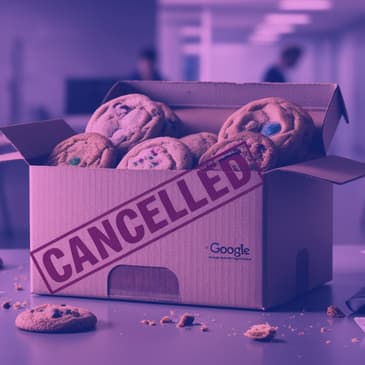
The great cookiepocalypse is cancelled. What does that mean for marketers now? The two-letter solution to improving your Google search ranking. Europe is coming after Meta again. And Amazon plays hardball.
Rate and Review Us • Contact Us
📰 Get our free daily newsletter
📈 Advertising: Reach Thousands of Marketing Decision-Makers
🌍 Follow us on social media or contact us
Get these exclusive benefits when you upgrade:
✅ Listen ad-free
✅ Back catalog of 20+ marketing science interviews
✅ Get the show earlier than the free version
✅ “Skip to story” audio chapters
✅ Member-only monthly livestreams with Tod
And a lot more! Check it out: todayindigital.com/premium
✨ Premium tools: Update Credit Card • Cancel
MORE
🆘 Need help with your social media? Check us out: engageQ digital
📞 Need marketing advice? Leave us a voicemail and we’ll get an expert to help you free!
UPGRADE YOUR SKILLS
Google Ads for Beginners with Jyll Saskin Gales
Inside Google Ads: Advanced with Jyll Saskin Gales
Foxwell Slack Group and Courses
Today in Digital Marketing is hosted by Tod Maffin and produced by engageQ digital on the traditional territories of the Snuneymuxw First Nation on Vancouver Island, Canada.
Some links in these show notes may provide affiliate revenue to us.
Privacy & Opt-Out: https://redcircle.com/privacy
[00:00:00] It is Tuesday, July 23rd. Today, the great Cookie Pocalypse is cancelled! So what does that mean for marketers now? The two-letter solution to improving your Google search ranking? Europe is coming after Meta again, and Amazon plays hardball. I'm Tod Maffin. That's ahead today in Digital Marketing.
[00:00:22] Well, Google has never been hesitant to shut down products or plans. I'm still pissed about them disappearing Google Reader, and that was like 200 years ago. Well, on brand, Google has cancelled something else. This time, it's plans to strip third-party cookies out of its Chrome browser.
[00:00:40] This was, of course, one of the biggest plans in the digital ad space, replace the aging tracking code with... well, they weren't sure. And turns out, that was part of the problem.
[00:00:52] Google tried lots of ways to claw back the data lost without those cookies, but it turns out there wasn't really a way to do it that both satisfied advertisers and maintained the privacy commitments that Google had promised and regulators had demanded.
[00:01:07] They were two sides of a teeter-totter that could never get in balance. Suffice to say, the decision took a lot of marketers by surprise. Google had been working on these plans for several years, delayed them three times.
[00:01:20] So what's next then? Nobody's quite sure. Even Google's not sure, though they did promise a vague new system, quoting from their statement, quote, instead of deprecating third-party cookies, we would introduce a new experience in Chrome that lets people make an informed choice
[00:01:37] that applies across their web browsing, and they'd be able to adjust that choice at any time, unquote. What that ends up being could be as simple as the don't-track-me switch that other browsers have had for years.
[00:01:49] Considering Google's primary revenue comes from ads, that's a switch they've been hesitant to offer. Well, in big Google news like this breaks, we turn to our Google ads correspondent Jill Saske and Gales for analysis.
[00:02:01] And Jill, I want to get your take on this. I feel like I didn't really do a very good job explaining the basics here. What are third-party cookies? Excellent question. Let's back up a step. What are cookies, right?
[00:02:12] So cookies are just little pieces of code that get dropped on your browser when you visit different websites. There are first-party and third-party cookies. So first-party cookies means the website you're visiting, like NewYorkTimes.com, is the one who drops that code,
[00:02:28] which means they can then recognize you when you visit their website again. That's first-party. Third-party means you're on the New York Times website, but Google drops a cookie on your browser to do things like track your behavior for Google Analytics or see if you convert for Google Ads.
[00:02:43] So because you're on the New York Times website, but Google's the one dropping the cookie, that is a third-party cookie. And again, it's just like it's a very old and simple, but in a way kind of elegant technology
[00:02:55] that enables websites to recognize you the next time you come back because they'll check your browser, they'll see that cookie, that piece of code, and they'll say, aha, this person was here before. Let's lob them in automatically or let's make a note that they're a returning visitor.
[00:03:09] And why did Google want to get rid of them in the first place? Is it all about sort of privacy concerns? People just don't like to be tracked? Pretty much. I don't think Google wanted to get rid of them as we can see now,
[00:03:19] but lots of pressure, understandably, from privacy groups. As I mentioned, it's an old technology. It can expose a lot of sensitive information to the browser, opportunity for that to be hijacked. So it just wasn't really safe. And there were a lot of drawbacks.
[00:03:33] Like, for example, you can't do cross-device tracking with cookies if someone visits on the phone and that opens up their computer. That would be two separate cookies, two separate users. There's definitely drawbacks to them. Google has been trying for many years to find other solutions,
[00:03:49] but alas, given up now and we're sticking with cookies. They really have, haven't they? We've seen flock, we've seen topics, we've seen the privacy sandbox. Every time they announced a delay of this,
[00:03:59] it seems like we're going to delay it. But look, we've got a cool new thing we're going to try. Why are third-party cookies so hard to replace? Well, in a way because this technology came out so long ago, it really is elegant in its simplicity.
[00:04:14] It just makes it super easy to be able to track user behavior online. And so all these other solutions are very highly engineered solutions and they're modeling and predicting and AI. And they just don't end up being as effective as good old fashioned,
[00:04:30] just tagging this person, tag your it. We could recognize you next time. So more engineering and more AI power does not always equal more effective results. And ultimately all these tests fail to deliver the same quality of audience data needed, the same conversion focused results that advertisers need.
[00:04:50] Have marketers moved past third-party? I feel like a lot of them have just kind of gone past and moving to first party now. Will this have any sort of day-to-day effect on advertisers?
[00:04:59] It absolutely will because the first thing to keep in mind is although Google Chrome is keeping cookies, there are other browsers out there like Safari, like Firefox that have killed cookies. So already your remarketing campaigns today are not as effective as they were a few years ago.
[00:05:14] Your conversion tracking today is not working as accurately as it was a few years ago. So you're already feeling that. And the second thing I'll say is because Google kept delaying and delaying I would bet that most businesses out there, especially smaller businesses have not implemented
[00:05:28] what we call the more durable solutions, things like enhanced conversions or offline conversion tracking or server-side tracking. You may have heard these terms banned about before but I would bet most advertisers haven't implemented them yet.
[00:05:42] Now that being said, even though third-party cookies are here to stay in Google Chrome because they're gone from other browsers and look, Google could change their mind again at any time.
[00:05:52] We've seen that happen before. I would still recommend that if you have not looked into a first-party data solution gathering customer email addresses, feeding that to your conversion tracking through enhanced conversions you should still do that even though third-party cookies are here to stay.
[00:06:09] All right, good stuff. Jill, thank you. Thank you. Well, if you're frustrated that Google isn't surfacing your brand's website as often as you'd like it to and are prepared to make big changes to fix it, you might try changing your domain name.
[00:06:26] Google search engineer Gary Ilias recently did a Q&A and confirmed that the search engine gives a ranking boost to domain names that end in country codes like .ca for Canada or .in for India or .kr for Korea. But there is one big catch.
[00:06:44] That ranking boost would only apply to people searching from that region. In other words, if your site ends in .ca and it's someone in Canada that's searching, you'll benefit but only a little.
[00:06:55] If you want to double down on this strategy, Ilias says what gives national results even more of a boost is using the language of that country as the language on your webpage. Quoting from him, quote, if the language of a site matches the user's query,
[00:07:10] that probably has more impact than the domain name itself, unquote. A search engine journal noted today, quote, using a top level domain from a country can inspire user trust from searchers whose country matches the country that the domain name is targeting and because of that,
[00:07:28] searchers on Google may be more inclined to click on a search results that uses the geo-targeted top level domain. Let's be honest, retros can be boring. And if you're the organizer, you know it's more than just running a meeting.
[00:07:45] You have to synthesize and categorize themes, get the team involved, assign next steps, and make it all a fun safe space where teammates want to participate. Miro is the visual collaboration platform that helps you run effective, engaging, and actionable retrospectives.
[00:08:02] We use Miro at our agency to map out a client's messaging for our engagement team. That can be complicated, a lot of if-vents, but making it visual and sharing it directly with our client sped things way up. Plus, our side can share spitballing ideas with private mode.
[00:08:18] The client doesn't get to see our thoughts until we've decided on the approach. Whether you work on the marketing side or in product design, engineering, or UX, bring your team together on Miro. And your first three Miro boards are free when you sign up today at Miro.com.
[00:08:36] That's three free boards at Miro.com. With Shopify you can only set up your online shop. Without programming or design knowledge. Thanks to the efficient education and intuitive social media and online marketplace integration, you can sell and sell ebay, ebay and co-purchase via Instagram.
[00:09:12] It was never easy to reach new target groups. Shopify offers a single, secure platform for all tools to build up your online business. Just try it out. Just try it out. Just try it out. And let's go! Made for Germany. Powered by Shopify.
[00:09:51] We have a list of all of the updates in today's email newsletter, which is free to sign up to. Just tap the link at the top of the show notes or go to the top of the show notes.
[00:10:02] And if you're interested in more information on how to do this, you can find the link in the description below. And if you're interested in more information about the campaign, you can find the link in the description below. And if you're interested in more information about the campaign,
[00:11:20] you can find the link at the top of the show notes or go to the top of the show or go to the top of the show notes. to boost product and business ratings on Amazon and BBB profiles. This is Amazon's first joint
[00:11:49] lawsuit against fake review brokers. Review Service USA did not respond to requests for comment. In 2022, Amazon sued AppSally and RebaTest for allegedly coordinating free items or money in exchange for false reviews. In late 2022, it also launched a campaign to help shoppers spot
[00:12:08] scams in the holiday season. Amazon has also introduced an AI tool last August to summarize product reviews for customers. Still have not cracked this damn puppy code, I swear. So I think we're getting closer. I think we're figuring out the puppy stuff a little bit more.
[00:12:27] If you miss all this, we adopted a puppy a few months ago and boy, we have been having a hard time convincing her where to poop or to be more specific where not to poop, i.e. the house.
[00:12:39] It's been tough. At first we had this kind of chart. Every time she'd poop or pee, we would note it on a kind of a day calendar and then I looked for like, you know, is it like early in the morning
[00:12:48] she tends to do it? Late at night. I think what we're learning is that it's not time-based, it's activity-based. Right after she eats, she should go out. Right after she plays, she should go out. So and I know puppy owners, dog owners, hell even parents probably
[00:13:04] laughing at us saying, you know, like, oh you sweet summer child. But my wife has been through puppy training once and that puppy apparently was a dream. So now the hard part. My wife goes away
[00:13:17] this afternoon for three days for a business trip and the puppy and I will be on our own. I don't know who's going to be more frustrated with who but there will be frustration. Anyway that's it for today. Thanks for listening. I'm Todd Maffin. See you tomorrow.
[00:13:31] Called the cellular phone. It's being heralded as a revolution in technology. Cellular phones are still expensive. Apart from the airtime, you pay a basic monthly service charge around $15. But by far the single largest expense is the hardware. You can lease a cellular phone set
[00:13:48] but you won't be able to buy one for less than $2,500. That's for a mobile model. The phone runs on your car's electrical system with an encyclopedia sized transducer in the trunk. The antenna can glue onto your rear window and a speaker attachment is available for your visor
[00:14:05] if you don't like the idea of driving with one hand on a phone.
[00:15:02] Shopify.de-tri