
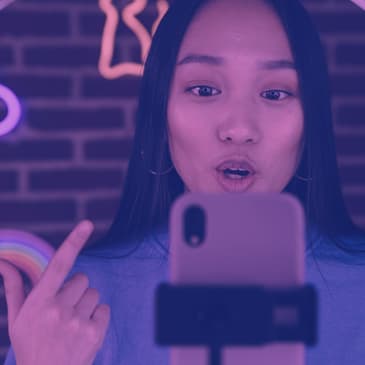
Sponsored videos have become an important marketing tool as the popularity of influencers has grown. In this special episode, Tod speaks with a business scientist who says she’s cracked the code for marketers.
.
📰 Get our free daily newsletter
📈 Advertising: Reach Thousands of Marketing Decision-Makers
🌍 Follow us on social media or contact us
.
Get these exclusive benefits when you upgrade:
✅ Listen ad-free
✅ Meta Ad platform updates with Andrew Foxwell
✅ Google Ad platform updates with Jyll Saskin Gales
✅ Back catalog of 20+ marketing science interviews
✅ Get the show earlier than the free version
✅ Story links in show notes
✅ “Skip to story” audio chapters
✅ Member-exclusive Slack channel
✅ Member-only monthly livestreams with Tod
✅ Discounts on marketing tools
✅...and a lot more!
Check it out: todayindigital.com/premium
·
GET MORE FROM US
🆘 Need help with your social media? Check us out: engageQ digital
🎙️ Our other podcast "Behind the Ad"
⭐ Review the podcast
·
UPGRADE YOUR SKILLS
• Inside Google Ads with Jyll Saskin Gales
• Google Ads for Beginners with Jyll Saskin Gales
• Foxwell Slack Group and Courses
Some links in these show notes may provide affiliate revenue to us.
·
Today in Digital Marketing is hosted by Tod Maffin and produced by engageQ digital on the traditional territories of the Snuneymuxw First Nation on Vancouver Island, Canada.
Privacy & Opt-Out: https://redcircle.com/privacy
[00:00:00] Do you want someone who understands you like no other? Someone who can be your true wish and wants to experience the most beautiful adventure of your life with you? The shopping platform Shopify revolutionizes millions of companies worldwide.
[00:00:15] With Shopify, you only focus on your online shop, without programming or design knowledge. Thanks to the efficient education and intuitive social media and online marketplace integration, you can sell and sell through Instagram, eBay and Co. It was never easy to reach new target groups.
[00:00:34] Shopify offers on a single secure platform all tools to build up your online business. Without any tests, you can present a business of the world. www.shopify.de.try Simply enter shopify.de.try and start. Made for Germany, powered by Shopify. It is Friday, December 8th.
[00:00:58] Today, sponsored videos have become an important marketing tool as the popularity of influencers has grown. In this special episode, I am speaking with a business scientist who says she's cracked the code for marketers. I'm Tod Maffin. That's ahead today in digital marketing. So why the special episode?
[00:01:19] It doesn't happen very often but maybe once or twice a year. Isn't there any interesting news to report? So today, we bring you a full-length deep dive into how the design of a sponsored video affects consumer engagement.
[00:01:37] Lee Chen is a professor of marketing at Sophoc University in Boston. She and her colleagues recently published a paper in the Journal of the Academy of Marketing Science called What Drives Digital Engagement with Sponsored Videos.
[00:01:49] I spoke with her earlier and started by asking her whether sponsored videos were received more positively or more negatively by consumers in terms of their willingness to engage with them. Positively. So that's one of the interesting findings in our study. So originally, we hypothesized a negative effect.
[00:02:10] We thought that clearly this closing sponsorship would hurt digital engagement, but our analysis shows the opposite. Why do you think that is? I think it indicates developments in influencer marketing in general, in the industry general,
[00:02:28] and also there is a change of consumer perception and attitudes towards sponsored videos. So maybe several years ago, when influencer marketing and sponsored content was still a new phenomenon, they were not familiar with sponsorships. They were not familiar with the collaboration between brands and influencers.
[00:02:53] Therefore, they expected that influencers to only produce organic content. So that was their expectation. But nowadays, influencer marketing is very popular. It develops really fast and sponsored videos also become very common. So viewers, well general consumers, they are exposed to sponsored videos a lot right now.
[00:03:18] They watch these sponsored videos on YouTube, on different video sharing platforms. So now they gradually understand what the collaboration is. And as they become more familiar with sponsorships, as they become more familiar with this type of collaboration, they gradually understand and accept this kind of collaboration.
[00:03:43] So they know that influencers need to make a living. They need to make money so that they can produce high quality content. Therefore, they are becoming more understanding and acceptable. But at the same time, there is this moral responsibility they expect.
[00:03:58] So they expect influencers to clearly disclose sponsorship. So that is what we believe the development in influencer marketing in general. And you know, it doesn't surprise me that as influencers become more part of the marketing ecosystem, that consumers would think less negatively of it.
[00:04:18] What surprised me about your research was that in fact, it went even beyond that and people began thinking positively about the brand when an influencer was brought in. That has something to do with authenticity. So now, followers expect them to be honest, to be transparent.
[00:04:37] Right? So if you are getting a sponsorship, just be transparent and be honest. Tell me you are getting this sponsorship. So I am fully informed about the content I'm going to watch. So that's some new moral responsibility. And also, influencers are like their followers' friends.
[00:04:58] Right? So there is this parasocial relationship going on. So I want the best for my friends. So if the influencer I like is getting sponsorship, I feel happy for them. Right? So now you are funded and I feel happy. I even celebrate with them.
[00:05:16] Like, oh, congratulations. You are getting this sponsorship. It's really a good thing. So that's another interesting finding in our study. Did your results differ when the platform was the one doing the disclosing? Like I'm thinking in something like the little label that says sponsored post. Yes.
[00:05:34] So we're looking to two types of disclosure. One is influencers' own disclosure in the video. The other one is platform-generated disclosure. So now large video sharing platforms like YouTube and Billy Billy, it's the platform in our study, they all offer this new feature,
[00:05:54] this disclosure feature influencers can apply. So if you apply this feature, there would be a platform-generated label appear on your video. It says it includes sponsored content or the content is sponsored by which brand? So that's a platform-generated label.
[00:06:15] So our study indicates that when you combine both types of disclosure, you all have higher digital engagement. Yeah, the data set as you mentioned came from Billy Billy and I like to think that I'm pretty up to speed on apps, but this one was new to me.
[00:06:32] It's a Chinese app, I think. Can you describe it? It is. It is. It is a video sharing platform in China and it's getting really popular in China in recent years, especially among younger people. It's like YouTube, so it's similar. Like everybody can register and post their videos,
[00:06:51] so they provide YouTube style, this kind of service. But I think they are much more popular among younger people in China. How do you think your results would be different if you'd have tested on a more global app like TikTok or Instagram or YouTube?
[00:07:08] I think... So there is one thing we do want to mention. In our sample, the average video length is seven minutes. So we study medium to long sponsored videos and we think as long as the video is in similar contexts,
[00:07:26] our findings should be generalized to other platforms like YouTube. But TikTok is different. TikTok is short videos. So the videos on TikTok are usually less than a minute. That would be a different context because in short videos,
[00:07:42] the amount of information you can include and the structure and the format may be very different. So our findings may not be directly transferable to these short video contexts. But in other platforms like YouTube, we do believe the findings can be generalized.
[00:08:01] Yeah, I mean the strategies we study are general video design strategies. They are not country specific or culture specific. That's why we think the findings can be generalized. I know that scientists do not like talking about their gut feeling. They prefer data and things that can be proven.
[00:08:23] But I'm going to ask you for your gut feel on how you think the results would be on TikTok. I think some of them may have similar impact. For example, disclosure. I think it could be similar because... In other words, positive for the brand? Yeah, I think so.
[00:08:41] But in terms of customization and subjective endorsement, it may be different because in one minute, let's say several seconds or one minute video, you can't fully customize or partially customize the video for the brand. The level would be different.
[00:09:03] So I would say video customization and the type of endorsement may have different effects. Let's walk through a couple of those minute factors that are commonly included in these kind of videos. You can tell me how they affect engagement. You mentioned high video customization.
[00:09:26] How does that affect it? Let me first explain what video customization is. There are different types of sponsored videos. At the lower customization level are shout out videos. Influencers, they only mention the brand names or the product for several seconds at some time in their video.
[00:09:49] The video content is basically now related to the sponsoring brand. They just acknowledge the sponsorship. That is shout out videos. On the higher level of customization are dedicated videos. The influencer may produce a video specifically for the brand. For example, a review video.
[00:10:11] In the entire video, they talk about the product, the brand, the functions, the performance. The entire video is specifically for the brand. That would be a highly customized video. That's what video customization measures. Our finding is that higher level of customization will negatively impact digital engagement.
[00:10:32] I've heard that anecdotally from marketers as well that on TikTok, especially, your findings were from a more of a YouTube type app. It's almost the ones that are thrown up by an influencer quickly that seem to be more authentic.
[00:10:52] Do you want someone who understands you like no other? Someone who can be your wish and experience the most beautiful adventure of your life with you? The Shopify commercial platform revolutionizes millions of companies worldwide. With Shopify you only manage your online shop, without programming or design knowledge.
[00:11:13] Thanks to the efficient design and intuitive social media and online marketplace integration, you can sell and sell through Instagram, eBay and Co. It was never easy to reach new target groups. Shopify offers all tools on a single secure platform to build your online business.
[00:11:32] Test free and present a business of the world. shopify.de-tri Simply enter shopify.de-tri and start. Made for Germany, powered by Shopify. We save space where teammates want to participate. Miro is the visual collaboration platform that helps you run effective, engaging and actionable retrospectives.
[00:12:11] We use Miro at our agency to map out a client's messaging for our engagement team. That can be complicated. A lot of if-vents. But making it visual and sharing it directly with our client sped things way up. Plus our side can share spitballing ideas with private mode.
[00:12:28] We're excited to see our thoughts until we've decided on the approach. Whether you work on the marketing side or in product design, engineering or UX, bring your team together on Miro. And your first three Miro boards are free when you sign up today at Miro.com.
[00:12:45] That's three free boards at M-I-R-O.com. What about when the brand is mentioned early on in the video versus at the end of the video? Do you think it's better to share your brand in your findings? Of course, there is a difference.
[00:13:01] Based on our findings, it's better to place the brand or talk about branding information at later stage in your video. While you can clearly disclose sponsorship, but talk about the brand in the later part of your video is better for your engagement. What about influencers' subjective endorsements
[00:13:22] like sharing personal experiences or opinions about the sponsored product? That's another interesting finding. Generally speaking, there are two types of information you can provide. One is subjective information, meaning that you talk about your own opinion, your own experience, your own thoughts about the brand. That's subjective.
[00:13:45] The other is objective. You focus on the facts. You talk about the facts about the product. In our study, we find that subjective endorsement, meaning that you talk about your own experience, your own thoughts about the brand or negatively impact digital engagement. Interesting. That surprises me.
[00:14:06] That also surprises us a little bit. The theory, we believe it may be because that subjective endorsement is hard to verify. It's your own experience. For example, I'm endorsing a snack and I'm telling you it's really delicious. You really should try it. That's my subjective opinion.
[00:14:30] But it's hard to verify. As viewers, they just don't know. They don't know whether it tastes good or not. It's just your own opinion, your own thoughts. Objective information is verifiable. For example, this snack is made of organic ingredients. Then I can easily verify the information.
[00:14:49] But subjective endorsement is not. If it cannot be verified, then viewers may become a little bit suspicious. They may feel, they may doubt. That's why we think it explains why the negative influence would appear. The perfect influencer video then that a brand commissions would be one,
[00:15:15] if I have this right, where it's low production values. There's not a lot of customization. The brand itself is not mentioned until the very end or close to the end and the influencer stays away from their personal opinions about it.
[00:15:28] Is that a fair estimation of kind of the perfect video as per your findings? I wouldn't say it's a perfect video but in terms of the digital engagement you can get, that would be better. How do you think that tracks against sales or conversions?
[00:15:46] Digital engagement is one thing and it's important but it's a little bit different stage of the funnel than what most marketers are aiming for. Did you give any thought or find any data around how that digital engagement might translate into sort of objectives further down the funnel?
[00:16:02] That really is a great question. But in our dataset, unfortunately, we do not have sales data because majority of the sponsored videos are awareness campaigns. In other words, the brands they want to increase the awareness of the brand, there are now sales campaigns.
[00:16:21] That's why it's very hard to collect sales data. In addition, sponsored videos are just a part of the promotion strategy. It's just a part of the marketing mix and there are other factors may come into play. So it's really hard to link the influence
[00:16:40] or the effect of the sponsored video directly to the sales data. But that would be great if further studies can look into that and that's maybe our future studies. What surprised you the most out of your results? I would say disclosure. Even in practice, most influencers
[00:16:58] and sponsoring brands are reluctant to clearly disclose this sponsorship or this collaboration but we find the opposite. So that's why we think it's really surprising. And as we talked about earlier, it could be the development in influencer marketing industry in general and also how people perceive sponsored content.
[00:17:23] So now they are more understanding and they are more familiar with this type of collaboration. So bottom line, how should marketers change how they work with influencers in light of your findings? It's okay to disclose your sponsorship. So don't feel reluctant to clearly disclose
[00:17:42] the sponsorship or the collaboration. It's completely fine. Consumers understand and they also appreciate that if you clearly tell them that this is sponsored, that's one thing. And also for brand information, well maybe move it to the later part of the video.
[00:18:00] So you still can talk about a brand but at the beginning, it's better to have the influencers own organic content and maybe talk about the brand later. And for customization, they just need to think about the objectives they would like to achieve in this campaign,
[00:18:20] this influencer marketing campaign. Well, it's still okay to produce customized videos but maybe brands and influencers want to take the digital engagement into consideration. The customization effort would pay. That's one thing they may want to think about. Finally, it's the subjective endorsement for influencers.
[00:18:41] Well, it's pretty common for them to talk about their own opinions and experience but they may be careful. So it's okay to talk a little bit but don't emphasize your own opinion or experience too much. Maybe also talk about the facts about the brands,
[00:19:00] not just your own opinion. It is fascinating research. I'm delighted you could share it with us. Thank you so much for your time. Lee Chen is a professor of marketing at Suffolk University in Boston. Her paper is in the Journal of the Academy of Marketing Science.
[00:19:15] It's called What Drives Digital Engagement with Sponsored Videos. And that will do it for the week. Today in digital marketing is produced by EngageQ Digital on the traditional territories of the Sunimic First Nation on Vancouver Island. Our production coordinator, Sarah Gilder,
[00:19:30] is dancing by Source Audio and Coordination by Red Circle. I'm Todd Mappin. Have a great weekend. See you on Monday. Are you using Shopify already? From innovative startups to family companies with long tradition? Shopify's commerce platform revolutionizes millions of companies worldwide. With Shopify, you can sell products
[00:20:13] via popular channels. Whether it's personal POS system or an existing e-commerce platform. Social media and websites like Facebook, Instagram and eBay are also supported. Thanks to the constantly growing selection of innovative functions and the reliable technical support, it's very easy to build your business with Shopify.
[00:20:34] Whether product presentation or order and payment development. Shopify offers everything you need for your business. That's how you can concentrate on your business. Shopify is free to try and bring your business forward. Shopify.de.try So, Shopify.de.try Made for Germany Powered by Shopify