
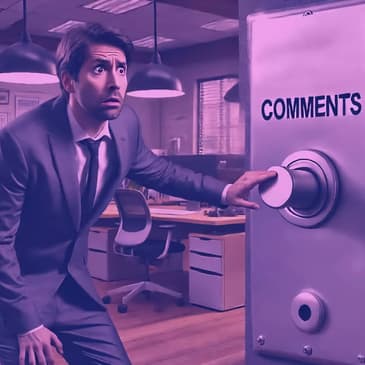
There are many decisions to make when you're posting an ad on social media for your brand — the placement, the timing, the audience, the hook, the creative.
But one factor that doesn't get talked a lot about is the comments. After all, social media ads are mostly just posts with a budget behind them — posts that can include comments.
That's great if your company has a lot of goodwill and gets positive comments; less so if you don't.
Which is why some marketers consider turning comments entirely off. Sure, you'd prevent negative comments, but what do consumers think of that strategy? Do they even notice?
Now, we have some answers thanks to a new study published in the Journal of Marketing called No Comments (from You): Understanding the Interpersonal and Professional Consequences of Disabling Social Media Comments.
Freeman Wu is the co-author of that paper. He is an Assistant Professor of Marketing at Vanderbilt University in Nashville Tennessee.
📰 Get our free daily newsletter
📈 Advertising: Reach Thousands of Marketing Decision-Makers
🌍 Follow us on social media or contact us
Get these exclusive benefits when you upgrade:
✅ Listen ad-free
✅ Back catalog of 20+ marketing science interviews
✅ Get the show earlier than the free version
✅ “Skip to story” audio chapters
✅ Member-only monthly livestreams with Tod
And a lot more! Check it out: todayindigital.com/premium
✨ Premium tools: Update Credit Card • Cancel
MORE
🆘 Need help with your social media? Check us out: engageQ digital
📞 Need marketing advice? Leave us a voicemail and we’ll get an expert to help you free!
⭐ Review us
UPGRADE YOUR SKILLS
Google Ads for Beginners with Jyll Saskin Gales
Inside Google Ads: Advanced with Jyll Saskin Gales
Foxwell Slack Group and Courses
Today in Digital Marketing is hosted by Tod Maffin and produced by engageQ digital on the traditional territories of the Snuneymuxw First Nation on Vancouver Island, Canada.
Some links in these show notes may provide affiliate revenue to us.
Privacy & Opt-Out: https://redcircle.com/privacy
[00:00:00] It is Monday, June 24th. I'm Tod Maffin. Are there many decisions to make when you're posting an ad on social media for your brand, the placement, the timing, the audience, the hook, the creative? One factor that doesn't get talked a lot about is the comments.
[00:00:18] After all, social media ads are mostly just posts with a budget behind them. Posts that can include comments. That's great if your company has a lot of goodwill and gets positive comments. Less so if you don't. Which is why some marketers consider turning comments entirely off.
[00:00:35] Sure, you'd prevent negative comments, but what do consumers think of you once you've done that? Do they even notice? Now we have some answers thanks to new research published in the Journal of Marketing. Freeman Wu is the co-author of that paper.
[00:00:49] He's an assistant professor of marketing at Vanderbilt University in Nashville, and he joins me now. Dr. Wu, welcome. Thank you. Thank you for having me, Tod. We should say off the bat your research looked at what happened when social media influencers
[00:01:03] turned off comments, not when traditional brands did. But I think there's still plenty of lessons that we marketers can learn for your work. Personally I only notice when comments are disabled when I go to comment myself. Do we know how many consumers even notice that comments are disabled?
[00:01:18] Yeah, so we ran a quick pilot study just to get a sense of like do people even notice these kinds of things? And so what we found in our study was that around 95% of people actually notice when comments are turned off. Wow.
[00:01:31] Whether it's because they themselves want to comment or they just want to read what other people have written about that post. And then of the 95%, we found that around 80% of them have noticed that public figures like influencers or celebrities have done so in the past.
[00:01:49] So it does seem to be something that consumers seem to be paying attention to. Let's use one of the examples from your study. You showed participants an Instagram post from Drew Barrymore. Tell me about that post and what you learned.
[00:02:03] So we actually ran a study that we adapted from one of Drew Barrymore's actual posts. And this was a post that she issued in response to last year there was a Hollywood writer strike. She basically ended up resuming her show despite the strike.
[00:02:20] And so she got caught, got called out for it and then she issued an apology. And so we took that actual apology of hers and then examined how consumers would actually react if her comments were turned off compared to if comments were left on.
[00:02:37] So we actually also compared what would happen if the comments were mostly negative. People saying mean things about Drew Barrymore. A lot of the comments were mostly positive like supporters coming to Drew Barrymore's
[00:02:51] defense and what happens if it's a mixed bag, which is probably what happens in reality. Some supporters coming to her defense and some detractors tackling her. And so what we found is that when comments were turned off, consumers responded more negatively to Drew Barrymore.
[00:03:09] They liked her less and they found her less persuasive compared to the other three conditions. So in other words, what I'm saying is consumers actually respond more negatively to comments being turned off compared to if comments were left on, even if they're mostly negative and unfavorable in nature.
[00:03:29] Oh, interesting. So reputationally it's still worse. It's still worse to just turn comments off as opposed to let a bunch of negative comments go in. Exactly. So that's actually what we found really surprising. We initially didn't have a strong prediction as to whether negative
[00:03:44] comments were going to be worse, whether it was going to be equal or more positive than turning off comments. But it does seem to be the case that consumers really, really dislike it when public figures like influencers and celebrities turn off their comments even
[00:03:59] if the comments are mostly negative. You also found that the negative impact of disabling comments actually didn't change based on engagement. The consumers felt equally shitty whether they had commented and engaged lots in the past or whether they were just passive viewers. Did that surprise you? Somewhat.
[00:04:22] So I mean, initially we expected that perhaps if people were big fans of a certain celebrity that they would respond negatively, that they respond differently as a function of whether comments were turned on or off. But it doesn't seem to be the case.
[00:04:39] It seems to what we find is that whether these consumers are very engaged or not, they still respond the same way when comments are turned off, which we actually also found a bit surprising. Did you study what happens when a consumer comments and then their comment
[00:04:57] is deleted and they find out about it? So we did not actually run that study, but we did think about it. And our intuition is that consumers will probably respond even more negatively because in this case, you're not only not letting me comment, but you're actively
[00:05:13] censoring me and actually deleting my comments, which I think would probably be the worst condition. We run a social media engagement agency. That's our core business here at the podcast. And we always tell our clients that the last resort we call it the
[00:05:27] nuclear option, the last resort is to delete actual comments because what happens is that then someone notices and then they say our comments are being deleted and now you've opened up a whole other can of worms.
[00:05:39] Well, do we delete the ones saying that they're just kind of becomes a little bit a bit nuts that way? Yeah. So consumers perceive accounts that disable comments as less sincere, but what's the downstream effect on that?
[00:05:51] Do those accounts lose followers or do they get negative comments once comments are turned on again? Like what actually happens other than people just kind of feel shitty about the brand? Right. So what we find is that, well, first of all, you form more negative
[00:06:06] impressions of these influencers and I mean, their bread and butter is the fact that they're generally likeable people. Right. So first of all, their brand name takes a hit. And then we've ran another study because oftentimes these influencers are promoting brands.
[00:06:19] Right. I mean, they that's how they get paid, right? For endorsing and sponsoring and saying nice things about these brands. We ran a study where we again have the influencer either turn off comments or left them on and then we had her promote.
[00:06:32] I mean, I think it was like a paper towel brand. And then afterwards we asked them like, hey, you know, we asked these participants, would you like to learn more about the paper towels, the brand that she was endorsing?
[00:06:42] Or would you like to complete some sort of activity? Right. Some other task. And we found that when comments were left on around 50%, right? 48% of them decided to learn more about the brand. But when comments were turned off, this number actually drops to 39%.
[00:06:59] Oh, wow. So not only is the influencer themselves taking a hit, but the brands that they partner with are also being penalized in a sense when comments are turned off. And you know, I mean, that 11% difference, if my math is right,
[00:07:13] it can really make or break a brand in terms of, you know, if it's a very small profit margin or they're highly competitive. Most definitely. It's easy to lose track of the big picture when you have to open a new window for every detail.
[00:07:26] With Miro, you can bring everything and every one together in one place, consolidate different points of view and increase team collaboration all on one centralized board. We used Miro at our agency to map out a customer journey map for one of our clients.
[00:07:42] And with the help of their huge template library, we were up and running in minutes. And the built-in commenting features helped us tweak it without a million back and forth emails. Find simplicity in your most complex projects with Miro.
[00:07:58] Your first three Miro boards are free when you sign up today at Miro.com slash podcast. That's three free boards at M I R O dot com slash podcast. At Parker, our purpose is simple. We want to make the world a better place by working more efficiently
[00:08:18] by using more sustainable practices, by developing better technologies we keep moving forward with each new idea, innovation and partnership. We're one step closer to fulfilling our purpose every single day. To find out more, visit Parker dot com slash purpose. Parker, engineering your success.
[00:08:40] In your paper, you found that one way that influencers can mitigate this negative impression was to disclose that they're going through some kind of like a personal crisis or a mental health challenge. Right. I guess I'm asking you, like if a brand were to disclose something similar,
[00:08:56] like, I don't know, sales are lower than they expected or they're or they're having trouble finding staff. Do you think that consumers might give them a pass on disabled comments as well or am I reaching there?
[00:09:09] I think it might be a bit of a reach, especially because with brands, it's not just one person behind that account. Usually, I mean, I think consumers infer that it's an entire team. It's entire social media marketing team.
[00:09:21] And so I think it would be less believable if a brand comes out and says, you know, we are salespeople. We're really struggling here. Right. Can you give us a break? You know, can can you give us a pass?
[00:09:33] I think it might be less believable compared to influencers where it is usually that one person who's, you know, who's behind that screen. Right. The one thing I thought was really interesting in your paper was that you mentioned that the social platforms actually use different
[00:09:46] language to disclose that comments have been disabled. X, for instance, says comments have been limited to a select group of users, which I mean, to me implies that some people are seeing it. But Facebook says comments have been turned off for everyone is the language
[00:10:03] that they use, even though practically it's still they're both doing the same thing. I know you didn't study that particular particularly, but do you think that difference in language can move the needle somehow? I think it definitely can.
[00:10:16] I think to the extent that the language conveys that it's, you know, comments are being turned off on a more case by case basis, right? That it's you are actively excluding certain people, but not excluding others. I think that's going to make consumers feel more left out.
[00:10:33] And then I think they're going to react more negatively compared to if, you know, if all comments are turned off, then I think, you know, people might not feel as, you know, the person who's turning off comments is being as unfair.
[00:10:44] Right. So I definitely think that the language that's used to communicate turning off comments can make a difference. What surprised you about your findings overall? I think what surprised us most was actually the fact that people hate comments being turned off more than seeing negative comments.
[00:11:02] Because, I mean, there's a lot of research, right? And social psychology suggesting that, you know, we tend to as people overweight negative information, right? And so we actually went in expecting people to respond just as negatively when they see negative things being written about the influencer.
[00:11:20] I compare it to when comments were turned off. But, you know, what I'm really surprising is that no, you know, comments being turned off actually does, in fact, you know, create the most negative reactions, which I think influencers and public
[00:11:34] figures oftentimes they don't, you know, they don't intuit ahead of time. Because, I mean, they oftentimes turn off comments presumably because they don't want others to see all the nasty negative things that others have written about them, right? I mean, usually, I mean, if you think about it
[00:11:47] intuitively, it's a pretty sensible face saving strategy. But our research basically suggests that you're actually better off just owning up to the negative feedback and letting people see what others have written about you rather than just turning off comments and, you know, coming across as a coward.
[00:12:01] You had a co-author on your paper. Who was that? Michelle Daniels and she's at the University of Alabama. Well, it's very interesting research. I'm really glad you could spend some time to share with us. Thank you so much. No, thank you, Todd. Thank you for having me.
[00:12:13] Freeman Wu is co-author of the paper No Comments from You, understanding the interpersonal and professional consequences of disabling social media comments. It was published last month in the Journal of Marketing. We have a link to the paper in today's show notes. I'm Todd Maffin. Thanks for listening.
[00:12:30] Back at you tomorrow with the news.