
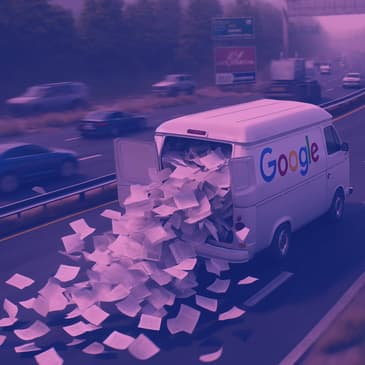
It's the biggest leak in Google's history — and the documents in it detail thousands of previously secret factors that decide how high you rank in their search engine. What are those factors, and have we been being lied to all this time?
We have extensive coverage today in this special episode.
Contact Us • Links to today’s stories
📰 Get our free daily newsletter
📈 Advertising: Reach Thousands of Marketing Decision-Makers
🌍 Follow us on social media or contact us
Get these exclusive benefits when you upgrade:
✅ Listen ad-free
✅ Back catalog of 20+ marketing science interviews
✅ Get the show earlier than the free version
✅ “Skip to story” audio chapters
✅ Member-only monthly livestreams with Tod
And a lot more! Check it out: todayindigital.com/premium
✨ Already Premium? Update Credit Card • Cancel
MORE
🆘 Need help with your social media? Check us out: engageQ digital
📞 Need marketing advice? Leave us a voicemail and we’ll get an expert to help you free!
⭐ Review us
UPGRADE YOUR SKILLS
Google Ads for Beginners with Jyll Saskin Gales
Inside Google Ads: Advanced with Jyll Saskin Gales
Foxwell Slack Group and Courses
Today in Digital Marketing is hosted by Tod Maffin and produced by engageQ digital on the traditional territories of the Snuneymuxw First Nation on Vancouver Island, Canada.
Some links in these show notes may provide affiliate revenue to us.
Privacy & Opt-Out: https://redcircle.com/privacy
[00:00:00] It is Tuesday May 28th.
[00:00:03] Today it's the biggest leak in Google's history and the documents in it detail thousands
[00:00:09] of previously secret factors that decide how high you rank in their search engine.
[00:00:14] What are those factors and have marketers been lied to all this time?
[00:00:20] We have extensive coverage today in this special episode.
[00:00:23] I'm Tod Maffin, that's ahead today in Digital Marketing.
[00:00:29] At first glance you might think the video is of a software engineer doing a job interview.
[00:00:34] He's got the software engineer uniform, pressed jeans, white polo shirt, neatly groomed facial
[00:00:39] hair.
[00:00:40] He's sitting down looking right into the camera.
[00:00:43] Hi there.
[00:00:44] Only this is no job interview.
[00:00:47] This is the guy.
[00:00:48] I'm the guy.
[00:00:49] This past weekend leaked Google's most important trade secrets.
[00:00:55] Because he's mad.
[00:00:57] For decades we've been lied to.
[00:01:01] Literally lied.
[00:01:04] His name is Efran Azimi and today he uploaded a video revealing that he was the person
[00:01:08] behind the massive weekend leak of internal Google search documents that sparked chaos
[00:01:14] in the marketing industry.
[00:01:16] He's mad because the documents, 2500 pages worth, seem to contradict what Google has
[00:01:21] told marketers for decades about how to rank higher in the search results.
[00:01:26] The leak is a set of confidential internal documents, API documentation to be precise,
[00:01:32] detailing Google's secret sauce, the parameters and levers that run their money printing
[00:01:38] search engine.
[00:01:39] We are devoting our full episode to this leak today, what's in it and what it
[00:01:43] means for you going forward.
[00:01:46] First though, a bit of background.
[00:01:48] For decades now, Google engineers and spokespeople have given marketers advice about how to
[00:01:52] rank better.
[00:01:54] That advice has been general.
[00:01:56] For the last several years it's basically boiled down to, don't worry about the algorithm,
[00:02:00] just make good content.
[00:02:03] But often that advice seems to contradict what practitioners are seeing in the search
[00:02:07] results.
[00:02:08] For instance, Google claims that click data isn't considered a significant ranking
[00:02:12] factor.
[00:02:13] That might be true, though many outsiders who've tried to test this says it doesn't
[00:02:17] seem to be.
[00:02:18] Until now we've just had to take Google's word for it.
[00:02:22] Essentially, is what Mr. Azimi says caused him to leak these documents.
[00:02:27] As Googleers came and directly said, especially from the search relations team, that certain
[00:02:38] signals such as Chrome data and click data are not used in the ranking.
[00:02:47] This is massive.
[00:02:49] Barry Schwartz has been covering the SEO industry for most of his career.
[00:02:52] He writes at seroundtable.com.
[00:02:54] I spoke with him this morning.
[00:02:56] It looks to be a legit release of Google's search factors of some sort in a real structured
[00:03:03] fashion so people can actually search it and so forth.
[00:03:05] It seems like a lot of the specific signals that Google may be using in some level
[00:03:10] for ranking has been fully released to the public, which is Google's secret sauce
[00:03:14] really.
[00:03:15] Mike King was one of two people who were first given the leak.
[00:03:18] He spent 18 years in the SEO industry.
[00:03:20] Today he runs the agency iPollrank.com.
[00:03:24] I spoke with him earlier today as well and asked him if this means the Google reps
[00:03:27] were just lying to marketers about what factors matter.
[00:03:30] There is this dynamic between them and the SEO community where because there's
[00:03:37] this kind of shield of information, they have some wiggle room to say things that
[00:03:45] misdirect us.
[00:03:46] I think something like saying that clicks don't impact rankings is something they
[00:03:53] have to say because they don't want everyone trying to manipulate clicks.
[00:03:57] That is their core signal that you're using to reinforce what should rank.
[00:04:03] If everyone goes out there and they just make a bunch of bots to click on
[00:04:08] things, then that signal is no longer valuable.
[00:04:11] So I don't think they've lied to us necessarily out of animosity or anything
[00:04:17] like that.
[00:04:17] I think they had to, but I think the problem is the way that they've done it.
[00:04:23] There is another possibility here too, that maybe the public facing reps that
[00:04:27] Google uses to talk with us about SEO, spokespeople, the evangelists, the
[00:04:31] liaisons, maybe they were inside the black box too and didn't even know it.
[00:04:38] Tom Kapper is senior search scientist at Moz.com.
[00:04:40] I wonder to what extent the people that are employed by Google to communicate
[00:04:45] with the SEO industry, what are to what extent they're in the dark here?
[00:04:49] Did they know that they were lying or has this stuff been a secret within
[00:04:55] Google?
[00:04:56] Lying might be a strong and judgmental word.
[00:04:59] Did they know that they weren't saying the whole truth, shall we say?
[00:05:02] Or were the firewalls within Google so substantial that actually they were
[00:05:07] being given the same information that SEOs were?
[00:05:11] I could believe something like that.
[00:05:13] The debate about was Google lying to marketers aside, the documents do
[00:05:17] reveal a lot more about the inner workings of the search engine than we
[00:05:21] knew before.
[00:05:22] Here are some of those highlights.
[00:05:24] First, there are about 14,000 ranking elements listed.
[00:05:29] The document did not detail the weighting of each element, just that
[00:05:33] they exist.
[00:05:34] There is a metric called site authority, which hadn't been previously
[00:05:38] disclosed and based on name alone seems to run counter to Google's claim
[00:05:42] that broad site trustworthiness was not a strong ranking metric.
[00:05:47] Third, content can be demoted in search ranking position if it's a
[00:05:51] product page with bad reviews.
[00:05:53] We were able to infer this from one of Google's recent updates, but
[00:05:56] nothing's been this clear.
[00:05:58] Fourth, Google apparently keeps a copy of every version of every page.
[00:06:03] It's ever indexed so it can go back and see what changes were made, though
[00:06:08] it only uses the last 20 content changes when analyzing links.
[00:06:13] Fifth, yes, links to your content still matter despite the direction
[00:06:17] away from them.
[00:06:18] Google spokespeople have tried to steer marketers.
[00:06:20] And six, there are penalties for domain names that exactly match
[00:06:24] unbranded search queries.
[00:06:26] For example, cheap fashion shoes.com or women's luxury watches.com.
[00:06:33] Use those domain names and your ranking will drop.
[00:06:37] It'll be hard for Google to claim this is an out of date document.
[00:06:40] It seems to have been updated as recently as March.
[00:06:44] The leaker says the documentation came from GitHub where software engineers
[00:06:47] store their code and documentation.
[00:06:50] These API documents had been protected and only accessible by
[00:06:53] specific Google employees, but between March and this month, those
[00:06:58] documents had accidentally been left open to the public.
[00:07:02] Think of it like a library, but as SEO veteran Rand Fishkin, who was the
[00:07:06] other person initially given this leak said in his blog post about this all
[00:07:09] quote, whereas libraries are public.
[00:07:12] Google search is one of the most secretive, closely guarded
[00:07:15] black boxes in the world.
[00:07:17] In the last quarter century, no leak of this magnitude or detail has ever
[00:07:22] been reported from Google's search division unquote.
[00:07:27] As for how much of the code is actively being used by Google's search
[00:07:30] engine, that's hard to know for sure.
[00:07:33] It's possible Google has since deprecated some of these factors.
[00:07:36] Some may have been internal only or were test API calls that
[00:07:40] were never implemented, but all that seems unlikely.
[00:07:43] Partially because the code clearly notes when features have been sunsetted.
[00:07:48] So what now given that some of the advice Google's given us in the
[00:07:51] past seems to have been misdirection at best should marketers
[00:07:55] change our SEO practices because of this?
[00:07:59] I don't see why.
[00:08:00] Again, Barry Schwartz.
[00:08:01] I don't see there's no reason to change your strategies.
[00:08:03] Ultimately you want to build content that people like, that people
[00:08:06] want to click on, that people want to consume, that people want to
[00:08:07] share, that people just want to go back to.
[00:08:10] So ultimately it's all in line with building out great content because
[00:08:14] that's the type of stuff that generates clicks, generates visits.
[00:08:17] People have long divorced SEO from user experience.
[00:08:22] This is Mike King again.
[00:08:24] I think the two need to work more closely together because ultimately
[00:08:27] you need someone to like come to your page and stay there.
[00:08:29] Like that is a signal that Google is using.
[00:08:33] Historically, we've all just been like, cool, let's just get them
[00:08:35] to the site, get them to the site and then, you know, leave
[00:08:37] the conversion to someone else.
[00:08:39] I think that we need to be thinking more about UX principles
[00:08:44] and how do we ensure that people get to the thing that they're looking
[00:08:47] for so that we can drive more successful sessions.
[00:08:51] Barry Schwartz is at seroundtable.com.
[00:08:54] Mike King is at ipolerank.com and Tom Kapper works at moz.com.
[00:09:00] For the record, we did reach out to Google for comment, but
[00:09:03] did not hear back by deadline.
[00:09:04] We have even more detail about these documents in today's email
[00:09:08] newsletter, including links to Barry's coverage, Rand Fishkin's
[00:09:11] full blog post, and Mike King's breakdown of what's in the docs.
[00:09:14] You can get all that by signing up to the newsletter for free by
[00:09:17] tapping the link at the top of today's show notes or going to
[00:09:19] todayindigital.com slash newsletter.
[00:09:22] Tomorrow, we will update this story with any reaction from
[00:09:25] Google on all this if they comment.
[00:09:27] Plus back to other stories making news this week, including PayPal's
[00:09:31] aggressive new push into the ad market.
[00:09:34] I'm Todd Maffin.
[00:09:35] Thanks for listening.
[00:09:36] See you tomorrow.
[00:09:40] Ah, the sizzle of McDonald's sausage.
[00:09:43] It's enough to make you crave your favorite breakfasts,
[00:09:47] enough to head over to McDonald's, enough to make you really wish
[00:09:52] this commercial were scratch and sniff.
[00:09:55] And if you're a sausage person now get two satisfyingly savory
[00:09:58] sausage, McGriddle sausage, biscuits, or sausage, burritos for
[00:10:01] just three 33 or mix and match price and participation may vary.
[00:10:05] Cannot be combined with any other offer.
[00:10:06] A combo meal, single item at regular price.