
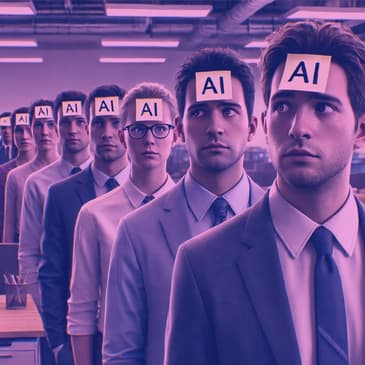
Did you use AI to make that product image? No? Then why is Meta telling everyone you did? Also: Local Service Ads expand to Maps, whether you want them to or not... unboxing goes big... YouTube editing goes long... and a dispute over programmatic ads heats up with advertisers caught in the middle.
Contact Us • Links to today’s stories
📰 Get our free daily newsletter
📈 Advertising: Reach Thousands of Marketing Decision-Makers
🌍 Follow us on social media or contact us
Get these exclusive benefits when you upgrade:
✅ Listen ad-free
✅ Back catalog of 20+ marketing science interviews
✅ Get the show earlier than the free version
✅ “Skip to story” audio chapters
✅ Member-only monthly livestreams with Tod
And a lot more! Check it out: todayindigital.com/premium
✨ Premium tools: Update Credit Card • Cancel
MORE
🆘 Need help with your social media? Check us out: engageQ digital
📞 Need marketing advice? Leave us a voicemail and we’ll get an expert to help you free!
⭐ Review us
UPGRADE YOUR SKILLS
Google Ads for Beginners with Jyll Saskin Gales
Inside Google Ads: Advanced with Jyll Saskin Gales
Foxwell Slack Group and Courses
Today in Digital Marketing is hosted by Tod Maffin and produced by engageQ digital on the traditional territories of the Snuneymuxw First Nation on Vancouver Island, Canada.
Some links in these show notes may provide affiliate revenue to us.
Privacy & Opt-Out: https://redcircle.com/privacy
[00:00:00] It is Friday, June 21st. Today did you use AI to make that product image? No? Then why is meta telling everyone you did? Also local service ads expands to Google Maps whether you want them to or not, unboxing
[00:00:15] goes big, YouTube editing goes long and a dispute over programmatic ads heats up with advertisers caught in the middle. I'm Tod Maffin, that's ahead, today in digital marketing. While I didn't see this on my AI takes over everything bingo card, meta is labeling images
[00:00:35] as having been made with AI. Images which were not in fact made with AI. And TechCrunch reports today this has been going on since last month. One example they showed was of a team winning a cricket league tournament.
[00:00:49] It's a real photo shot with a real camera held by a real human but the made with AI label shows up anyway. It's only visible on mobile apps and not the web. And lest you think this is just a bug, no.
[00:01:03] Because meta lives in a parallel universe, this is by design. Meta's system seems to be applying the label to any image where AI has even just touched the image. To add a small element with generative fill for instance.
[00:01:17] Pete Souza, the former White House photographer said all he did was flatten an image into a jpeg and that's all it took for meta to apply the label. Quote, what's annoying is that the post forced me to include the made with AI even though I unchecked it unquote.
[00:01:32] Also, Souza did this photographic work not on Meta's own platform, but using an Adobe tool. Still, meta applied the tag. That's because meta is honoring some new technical standards, C2PA and some from the IPTC. This lets software add metadata identifying that some AI took place.
[00:01:51] This means that meta can identify when images touch AI from all the major sites. Google, OpenAI, Microsoft, Adobe, MidJourney and Shutterstock for instance. This means that even if all you do is remove a tree branch from the background
[00:02:05] using Adobe's generative fill, Adobe will dutifully slip some metadata in. Meta will pick that up and report that, well, imply that the whole image was conjured out of thin air. This is more a language issue of course and the industry still hasn't figured
[00:02:21] out how to handle granular use of image AI. There's a big difference between made with AI and touched up by AI, but do we even really need that? Removing items from backgrounds has been something photographers have done since the invention of the medium.
[00:02:37] And even recent technology like Pixelmator's repair tool can do this and doesn't use any of the new generation AI. To be fair, once you tap Meta's label, it does explain things a bit better.
[00:02:48] It reads, generative AI may have been used to create or edit content in this post. But nobody taps that. As for marketers, this might actually become a bigger issue as the months go on. There are national elections happening this year all over the world.
[00:03:04] France, Ghana, Mozambique, the UK, Austria. I feel like I'm missing another one. It'll come to me. Elections of course are a breeding ground for misinformation and we may very well see consumers form worsening opinions about generative AI.
[00:03:20] Marketers could very well end up having the same labels applied to their images as some big scandals. And that's no good, no matter how hard you or Meta spin it. Oh, Venezuela. That's the one I forgot. July 28th.
[00:03:38] If you run local service ads with Google, you might soon start getting more impressions and maybe more leads. Google says it will start showing local service ads on Google Maps, first on the iPhone Google Map app, then others to come after.
[00:03:53] An email Google sent to advertisers reads, quote, we'll use your business's existing ad data and user reviews on Google Maps to create these ads. You don't need to share any additional data or details with us.
[00:04:04] The billing and pricing for these new ads will remain the same as what they currently are for search ads. You'll only be charged for qualified leads and your existing bids will be used, unquote. One interesting note there is that this change means LSAs will start using
[00:04:18] reviews from your Google business profile, which are generally considered a little more authentic than the ones previously attached to LSAs on their own. If for some reason you'd rather not have your ad surface in Maps, here is the process for opting out. Turn off your ad campaign entirely.
[00:04:34] That's right. There's no way to opt out other than to just stop running your ads, including your search ads. So your TikTok influencer marketing campaign was a hit. Dozens of creators jumped in, made some unboxing UGCs for you and you thought, how can we keep this buzz going?
[00:04:54] Of course, you can just throw them all into one ad and then run that ad on the app, but maybe you're looking for something with more impact. TikTok says it's got a solution and one that's not even in the app at all.
[00:05:05] Last year, it launched a program called out of phone, riffing on the industry standard term for outdoor media known as out of home. This includes billboards, in-store displays, movie ads, and so on. Today they are bringing that out of phone program to their branded mission
[00:05:20] product and the naming geniuses there are calling this creation out of phone branded mission. Quoting social media today, quote, branded mission, which TikTok launched in 2020, lets brands post participatory campaigns, which creators can then choose to participate in brands, can then select their favorite creator
[00:05:38] videos on the theme and amplify them through boosted ad traffic. The new out of phone branded mission will essentially incorporate user generated content into its off platform outreach so that brands can use UGC and their expanded promotions unquote.
[00:05:54] TikTok says the film company lions gate was one of the brands testing this to promote a hunger game sequel. The campaign took over most of the iconic screens in Times Square. And as TikTok said, the news release this week, quote, everyday
[00:06:05] creators were given their spotlight moment on the billboards, unquote. No word on pricing yet. But don't be surprised if this is priced a little higher. Earlier this week, we reported on a nasty dispute between the programmatic ad platform, the trade desk and Yahoo.
[00:06:25] In a nutshell, Yahoo was categorizing the trade desks programmatic ads as in stream when sold through open marketplaces. Those types of ads generally are sold at a higher price than what the trade desk wants. It says its content should be in a category called accompanying content.
[00:06:40] The spat got so heated that the trade desk said it would prevent advertisers from buying Yahoo's video inventory on its open marketing platform by this week, if Yahoo didn't capitulate. They didn't. And now we've learned the trade desk has followed through on the threat.
[00:06:56] Now a new deadline, July 1st. That's when the trade desk says it will also disable access to all of Yahoo's video inventory, including those bought through private marketplace deals. The trade desk is generally considered to be one of the largest programmatic platforms in the industry.
[00:07:12] A Yahoo executive did not mince words, quoting Aaron Miller, the VP of corporate communications at Yahoo, quote, the timing of this deadline coinciding with the kickoff and wrap up of cans appears to be an arbitrary and publicity seeking efforts by the trade desk at Yahoo's
[00:07:27] expense, especially given the incredibly low amount of revenue. This represents for both companies. We are still in negotiations and intend to make business decisions on a timeline that allows us to do what's right for our clients, partners and business.
[00:07:41] In addition, we are aware that the trade desk turned off deals, but we have not seen a change in spend from advertisers this week. Unquote. Some insiders say part of the problem comes from the way the industry has defined the definition of in-stream video ads right now.
[00:07:57] They say it's pretty loose and subjective. Quoting DigiDay quote, for example, some would declare small video players in the corner of a webpage as in-stream, as long as they ran video ads before or after editorial content, a definition that few would publicly advocate according to sources.
[00:08:15] Meanwhile, the latest guidelines state in-stream video must be set to sound on by default at player start or have explicitly clear user intent to watch the video content. While there may be other content surrounding the player, the video content must be the focus of the user's visit, unquote.
[00:08:33] So far, no budgeting from either side as this new July 1st deadline approaches. And that will bring us to the lightning round. YouTube will now let you edit your really long videos until now, if your video was six hours or longer, you couldn't edit it on the platform.
[00:08:54] Now you can, this should be out to everyone by the end of the month. You can also now select and act on multiple comments at a time in your YouTube channel's published tab. Until now, you could only do that inside YouTube studios held for review tab.
[00:09:08] New research has found that two thirds of advertisers between 2019 and 2021 unknowingly bought programmatic ads on websites that contained misinformation. The study looked at 9 million ads from more than 42,000 advertisers on 5,400 websites. And as the weather warms up, people are flocking to theaters.
[00:09:28] Industry watchers say there was a 41% increase in cinema ad spending in Q1 of this year compared to the same quarter last year. It's easy to lose track of the big picture when you have to open a new window for every detail.
[00:09:44] With Miro, you can bring everything and everyone together in one place, consolidate different points of view and increase team collaboration all on one centralized board. We used Miro at our agency to map out a customer journey map for one of our
[00:10:00] clients and with the help of their huge template library, we were up and running in minutes and the built-in commenting features helped us tweak it without a million back and forth emails. Find simplicity in your most complex projects with Miro.
[00:10:16] Your first three Miro boards are free when you sign up today at Miro.com slash podcast. That's three free boards at Miro.com slash podcast.
[00:11:23] Powered by Shopify. And a programming note, as you know, during the summer, we are moving Monday's news to our Tuesday episodes. That's because the news tends to be pretty slow on Mondays. This is especially the case in the summer, but this Monday I will be back
[00:11:35] in your ear holes with a special deep dive marketing science episode. I'll be speaking with a researcher who studied the brand impact on turning comments off on social media posts versus the impact of leaving them on. Even if that means people leave and see negative comments, the study's
[00:11:55] results, I promise will surprise you. That's this Monday. Yesterday's episode you may have noticed was about 10 or 15 minutes late. That is because I was busy during the day negotiating an arms deal. So I play Fallout 76 and one of the things you do at end game when
[00:12:13] you sort of threw it all is to try and get like the best weapon in the game and they're, they're random. These weapons are dropped randomly. The one I wanted is called a bloodied weapon, meaning the lower health I am, the more damage it does.
[00:12:23] I tried to find it in player vendors. I couldn't find it. I tried to make one. It wasn't coming up. So yesterday this kid who watches my stream and is in my video game discord and I were negotiating a price for a bloodied weapon with a 50%
[00:12:38] increase in critical chance and a 90% reduction in weight. This is what we gamers in Fallout 76 would call a god role. It is a, one of the best weapons in the game. Anyway, we came to a deal 15,000 caps. Caps is the currency.
[00:12:51] We, I didn't spend real money on it. Of course, although people do anyway, just to give you a, put that in perspective, the, the, the max number of caps you can have is 40,000. So I basically spent like, what is that?
[00:13:03] A third of everything that I had in the game to get this one gun. And I got it and it's okay. You know, it's okay. I, you know, it's sort of at the end of the day, it sort of makes my weapon go
[00:13:17] from killing something in eight bullets to killing something in five bullets. And then I sort of reflected on it. It's like, you know, I've been spending probably two or three weeks grinding for enough cores to be able to get that effect. And I never did.
[00:13:28] And am I really using my time wisely? Anyway, that will do it for the week today in digital marketing is produced by engage Q digital on the traditional territories of this new name, first nation on Vancouver Island. Our production coordinator is Sarah Guild.
[00:13:45] Our theme is by Mark Blevins ad coordination by red circle. I'm Todd Mappin. Have a restful weekend. I'll see you Monday for that marketing science deep dive episode and Tuesday for the regular news.