
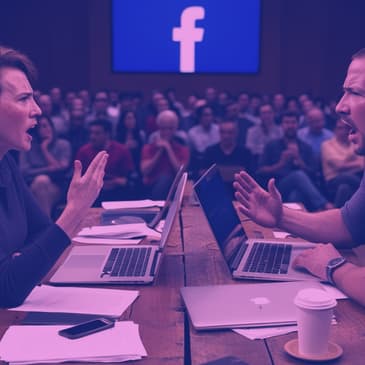
If you manage your brand’s social media channels – particularly the replies to your post — you’ve probably seen the comments. One person complains about something, then a second person replies to THAT making fun of the original commenter.
What do you, as the brand manager do? Do you hide the reply? Hide both? Or let them stand.
The answer has largely depended on your brand’s personality and, sometimes, let’s face it, the mood that day of the social media manager.
But what if there IS a right answer here — if we care about the hard metrics like purchase intent, how should we handle a series of negative comments on social media?
That’s what Todd Bacile and his colleagues set out to discover. He is an Associate Professor of Marketing at Loyola University in New Orleans. The paper is called “Schadenfreude and Sympathy: Observer Reactions to Malicious Joy During Social Media Service Recovery” — it was published recently in the Journal of Interactive Marketing.
Today in this deep-dive episode, Tod interviews Dr. Bacile about his findings.
.
📰 Get our free daily newsletter
📈 Advertising: Reach Thousands of Marketing Decision-Makers
🌍 Follow us on social media or contact us
.
Get these exclusive benefits when you upgrade:
✅ Listen ad-free
✅ Back catalog of 20+ marketing science interviews
✅ Get the show earlier than the free version
✅ “Skip to story” audio chapters
✅ Member-only monthly livestreams with Tod
And a lot more! Check it out: todayindigital.com/premium
✨ Premium tools: Update Credit Card • Cancel
.
MORE
🆘 Need help with your social media? Check us out: engageQ digital
.
UPGRADE YOUR SKILLS
Google Ads for Beginners with Jyll Saskin Gales
Inside Google Ads: Advanced with Jyll Saskin Gales
Foxwell Slack Group and Courses
.
Today in Digital Marketing is hosted by Tod Maffin and produced by engageQ digital on the traditional territories of the Snuneymuxw First Nation on Vancouver Island, Canada. Associate producer: Steph Gunn.
Some links in these show notes may provide affiliate revenue to us.
Privacy & Opt-Out: https://redcircle.com/privacy
[00:00:00] Spark something uncommon this holiday with just the right gift from Uncommon Goods.
[00:00:06] The busy holiday season is here and Uncommon Goods makes it less stressful, with incredible hand-picked gifts for everyone on your list, all in one spot.
[00:00:16] Gifts that spark joy, wonder, delight, and that it's exactly what I wanted feeling.
[00:00:21] They scour the globe for original, handmade, absolutely remarkable things.
[00:00:26] Here's a couple that stood out for me. They have a subscription recipe service, but the recipes are from historical figures and come in handwriting, sometimes literally on the back of an envelope.
[00:00:36] And do you remember those 3D Viewmaster things you had as a kid you'd look through?
[00:00:40] They have those, but they will take 10 of your favorite photos, 3D them, print them on that round card that you pop into the viewer and send it to you.
[00:00:49] It looks really, really cool.
[00:00:50] Get 15% off your next gift. Go to UncommonGoods.com slash today. That's UncommonGoods.com slash today.
[00:01:01] It is Monday, November 18th. I'm Todd Maffin.
[00:01:04] Today, a special deep dive marketing science episode.
[00:01:08] If you manage your brand's social media channels, particularly the replies to your posts, you've probably seen the comments.
[00:01:15] One person complains about something, then another person replies to that, making fun of the original commenter.
[00:01:22] What do you, as the brand, do?
[00:01:25] Do you hide the reply? Do you hide both or let them stand?
[00:01:29] The answer has largely depended on your brand's personality and sometimes, let's face it, the mood that day of the social media manager.
[00:01:38] But what if there is a right answer here? If we care about the hard metrics, like purchase intent, how should we handle a series of negative comments on our social media channels?
[00:01:50] That's what Todd Basile and his colleagues set out to discover. He is an associate professor of marketing at Loyola University in New Orleans.
[00:01:57] The paper is called Schadenfreude and Sympathy, Observer Reactions to Malicious Joy During Social Media Service Recovery.
[00:02:04] It was published recently in the Journal of Interactive Marketing.
[00:02:08] Dr. Basile joins me from his office in New Orleans.
[00:02:11] Welcome.
[00:02:12] Todd, thank you for having me.
[00:02:13] You're welcome. I should say before we begin, your research had some profanity in it.
[00:02:16] So parents, there is your official warning.
[00:02:19] So can you give me some examples of what this would look like on social media?
[00:02:23] What are we talking about here?
[00:02:24] What are these comments?
[00:02:25] Let's say it's like a social media, like a coffee shop brand.
[00:02:28] Okay.
[00:02:28] So we live in a very polarized area or era right now.
[00:02:33] People are speaking more and more rudely online for a number of different reasons.
[00:02:38] There's been a lot of research.
[00:02:40] There's academic, there's anecdotal evidence.
[00:02:43] It's simply people, they talk differently because they are behind a screen instead of in person.
[00:02:49] And so people express more views and use colorful language.
[00:02:54] Let's put it that way.
[00:02:55] And so my research examines that I'm a service reacher.
[00:02:59] I examine complaint handling.
[00:03:00] And one thing I noticed when I was doing my dissertation at Florida State University about 10 years ago is that when, when somebody complains in person versus if they complain on social media to a brand, how other customers behave, not the person who's complaining, but other, other people that are there.
[00:03:17] They behave differently.
[00:03:18] Now, if you talk about a coffee shop in person, if you have a bad cup of coffee and you voice your displeasure to the, to the customer service rep, there's an excellent chance.
[00:03:30] If you were to say, you know, this coffee tastes terrible.
[00:03:33] It tastes like, you know, motor oil is three days old.
[00:03:35] Would you please give me another one?
[00:03:36] It would be very rare.
[00:03:38] I would say that the person next to you would say, Hey, why don't you go jump in a lake?
[00:03:43] There's nothing wrong with that coffee.
[00:03:45] You know, quit being a jerk and get out of here.
[00:03:47] Why don't you never come back?
[00:03:49] You haven't met my family clearly.
[00:03:50] Okay.
[00:03:52] But online, we see a lot of that.
[00:03:54] And like I said before, the different social norms, there's that, that, uh, safety net that I can speak rudely to someone.
[00:04:01] They're not going to punch me through the screen.
[00:04:02] I'm not going to really get in trouble.
[00:04:03] The police are gonna, the internet police aren't going to arrest me.
[00:04:06] Um, and so I, I started the study complaint handling, uh, in particular, not just how the brand handles it, but when other customers become involved, how does that affect some of the observer reactions?
[00:04:19] How does that, how does that affect the reaction of the complainant?
[00:04:22] How does a brand handle all that?
[00:04:23] And maybe most importantly, how does it affect the brand?
[00:04:27] What do people think about the brand purchase intent, loyalty, satisfaction, things of that nature?
[00:04:32] I want to get to those findings in a minute, but you refer to these negative comments as C to C, in other words, consumer to consumer schadenfreude.
[00:04:41] But isn't this just trolling?
[00:04:43] What's the difference?
[00:04:45] So trolling is a very interesting term.
[00:04:47] I've had to study that mostly because when I submitted my research, the reviewers have often said, okay, so I've read different definitions of trolling.
[00:04:55] What is it?
[00:04:56] So trolling has a number of different, you can be an internet troll.
[00:04:59] In internet troll, people think of that person as, you know, someone in the dark underbelly of the internet, right?
[00:05:05] Someone who just, they're, they're living in their mom's basement.
[00:05:08] They don't have a job.
[00:05:09] Uh, they're, they're drinking too much and they're just going off on a tangent, anyone they talk to.
[00:05:14] Uh, but if you want to get technical about it, we all can exhibit troll like behavior.
[00:05:20] I mean, trolling different definitions.
[00:05:22] If it's simply just trying to, you know, push somebody's buttons, just trying to get a few jabs in there.
[00:05:27] I mean, at times we all do that from time to time.
[00:05:30] It doesn't make us trolls.
[00:05:32] Uh, but anyone at any time can exhibit troll like behavior.
[00:05:35] So what I'm looking at are specific emotions.
[00:05:38] This particular paper looks at a shot and for it, and also looks at sympathy.
[00:05:43] And we actually do, uh, we do some manipulations where we have those comments coming from someone who appears to be an internet troll, uh, versus someone who appears to be a loyal customer.
[00:05:53] Uh, now back to your point.
[00:05:55] Um, you could say this is trolling, but like I said, a lot of people view a troll as this really special case of someone who's really rude.
[00:06:07] Uh, but I would come back with that is, but at any point, anyone, I mean, and I, I see a lot of examples.
[00:06:14] This is my research.
[00:06:15] You'll see a loyal customer, someone with that badge on their, on their, you know, popular user or power user.
[00:06:22] And so it's someone who knows a lot about the brand and they'll speak rudely to someone else.
[00:06:26] If they think that person is overstepping whatever norms that they think are, are present in that page.
[00:06:32] So, um, yes, to answer your question, it is a form of trolling, but I'm also examining.
[00:06:37] Some of the reactions from that.
[00:06:39] And what were those reactions?
[00:06:41] What did you learn?
[00:06:42] Okay.
[00:06:42] So, uh, this particular paper looks at observer perceptions.
[00:06:46] And the reason why I like to study observers, you have one person complaining to one particular brand.
[00:06:52] But as you know, if you're on any popular social network, there could be dozens, hundreds, thousands, tens of thousands of other people that can see that.
[00:07:00] And some may react to it, meaning they might click the like or the reshare.
[00:07:04] Uh, some may comment.
[00:07:05] A lot of people may just digest the information and not do anything.
[00:07:08] So that observer group is really large.
[00:07:11] Uh, and so if you just want to look at sheer numbers, it's the largest stakeholder group.
[00:07:14] So that's why I thought it'd be interesting to study that.
[00:07:17] And so what we set out to do is, uh, look at, uh, schadenfreude and sympathy.
[00:07:21] And for people that don't know, just a quick definition, schadenfreude, it's simply amusement or pleasure felt due to another's misfortune or another's adverse event.
[00:07:30] So if you feel happy that something bad happened to someone, that's a good example of schadenfreude.
[00:07:36] Uh, sympathy is a feeling of concern or compassion when, uh, when, when some, when someone else has, uh, a negative situation.
[00:07:44] And so it's a lot of people look at sympathy and empathy, uh, as, as, uh, synonymous, not quite empathy is when you understand and reproduce in others emotion.
[00:07:54] And in my research, I think it'd be hard to reproduce the emotions of people observing something.
[00:08:00] I really, really wouldn't be able to do that.
[00:08:01] But as far as studying sympathy, just being an understanding, do you feel concern or compassion if something bad happens to someone?
[00:08:08] That's something that I thought we could study with this particular paper.
[00:08:11] Uh, and I will note this in marketing, there's not been a lot of research on schadenfreude and sympathy that there has in particular streams, but none that I found in customer service in particular, none that I found in customer to customer interactions on social media, customer service.
[00:08:27] So, uh, this particular study looked at will observers perceive that somebody's root comment, uh, is, is considered to include schadenfreude.
[00:08:36] So it's considered to include that person is, is feeling happy.
[00:08:41] That's something bad happened to someone.
[00:08:42] So if you complain to the coffee shop on their social media page, the person that's complaining, if someone comes along and posts a really rude and simple comment, when other people look at that rude comment, are they going to think that that person who responded is experiencing schadenfreude?
[00:08:56] So we just call that observers perceive schadenfreude.
[00:08:59] And under what circumstances was sympathy higher for the brand?
[00:09:03] Now we didn't study sympathy toward the brand.
[00:09:06] We studied sympathy toward the complainant.
[00:09:08] So you have, you have a person complaining, you have another person come along and posting a rude comment.
[00:09:13] When observers see that, do they perceive that rude comment to exhibit schadenfreude?
[00:09:19] And if so, do they perceive, uh, do they develop sympathy for the complainant, the person where the rude comment, the person who's being attacked by that, by that rude attacker.
[00:09:29] And, uh, what we found is that as sympathy as, excuse me, as, as schadenfreude goes up, um, uh, sympathy increases.
[00:09:36] And as sympathy increases, we found that purchase intent goes down.
[00:09:40] Help me connect the dots.
[00:09:41] So purchase intent of people who are observing this interchange between commenter one and rude commenter two.
[00:09:51] Is that what we're talking about?
[00:09:52] Correct. Yes.
[00:09:53] Okay. Yes.
[00:09:54] Interesting.
[00:09:55] And so that large stakeholder group, again, largest possible group out there, you know, you have one complainant, you have one rude attacker, you have one brand, you have potentially, you know, tens of thousands.
[00:10:03] So we studied the, the, uh, from the observer perspective, if you see these rude comments, would you feel bad for this person being attacked?
[00:10:12] And if nothing is done about it, would you want to, do you have a higher or weaker purchase intent toward the firm?
[00:10:18] And what we found is that if it's not addressed, then the purchase intent goes down.
[00:10:23] How do brands address it then?
[00:10:24] Do they hide it?
[00:10:25] Do they respond directly?
[00:10:26] Actually, you tested a few different responses.
[00:10:28] Yeah.
[00:10:28] So we actually did three studies on this paper.
[00:10:30] Study one was, was a netnography.
[00:10:32] Basically we were looking at real world posts and trying to determine what percentage actually included schadenfreude comments.
[00:10:38] Uh, we found about 25%, uh, which is a large number.
[00:10:41] One in four posts is, you know, there's hundreds, if not thousands of posts and different brands pages.
[00:10:46] So if one out of four contain this thing that we're studying, that was really interesting.
[00:10:51] Now I do, I should say just, just to take a clarity here, your, these numbers came from a fast food restaurants, which have a higher proportion of negative feedback and B from Facebook as the platform that you were measuring.
[00:11:03] And I would argue Facebook is a little bit more toxic to begin with.
[00:11:07] No.
[00:11:08] Well, it depends.
[00:11:09] Uh, no Facebook has an older demographic in recent years.
[00:11:12] And so some people make the argument, you know, younger people talk differently.
[00:11:17] They talk more rudely versus people that are, you know, 50 or 60 years old.
[00:11:21] And I mean, you could argue that point, but, um, I don't think Facebook is any, I don't think it's significantly more negative than other social networks, but that's just my, my opinion.
[00:11:32] Um, the identity, the perceived identity of that rude attacker, that rude commenter made a big difference.
[00:11:40] And we, we use different cues to present that person as more troll-like or more like a brand advocate, like a loyal customer.
[00:11:48] Um, we had different cues, for example, in the loyal customer cue and the screenshot that people saw, it said, um, uh, uh, loyal customer.
[00:11:56] Uh, and they had, they had a large follower count and they were, they were given a description.
[00:12:00] This person posted a lot.
[00:12:01] They know a lot about the brand for the troll.
[00:12:03] We didn't, we didn't do any of that.
[00:12:05] Um, what we found is that if the root comment is coming from the troll, it, it is, uh, it affects sympathy less.
[00:12:12] If it comes from the brand advocate, sympathy increases.
[00:12:15] This is really important because a lot of brands love it when their customers go on there and speak kindly about the brand, positively about the brand.
[00:12:25] So think about this person a complains of the coffee shop person B comes along and tells them, you know what?
[00:12:31] Why don't you go eat a bullet dick?
[00:12:33] This is terrible.
[00:12:34] You know, there's nothing wrong with the coffee.
[00:12:36] You know, you're a princess go back, you know, and you know, go to, go to some other place.
[00:12:41] Don't come back here again, you jerk or more, more colorful language than that.
[00:12:44] Uh, if that comment comes from a troll, there wasn't nearly as much sympathy for that complainant, the target of those root comments versus if that comment came from a loyal customer.
[00:12:54] And so a lot of brands, maybe the brand thinks that maybe they want to tell the customers complaining, Hey, why don't you go jump in the lake?
[00:13:02] But they can't really say that, right?
[00:13:03] Cause it's going to be, you know, it's going to be, uh, bad for customer relations, but some brands, and I talked to some managers and handle social media and I've shown them some of my work.
[00:13:13] And they told me, we love when customers talk like that.
[00:13:16] We love it when they come to our defense, cause we want, we want to tell that person, yeah, go to hell, but we can't.
[00:13:21] But if some other customer does it and we didn't tell them to do it, that's great.
[00:13:25] They're almost coming to my defense.
[00:13:26] But actually what I found was that's not a good thing because sympathy is actually higher.
[00:13:31] And if sympathy goes up, purchase intent goes down.
[00:13:33] Um, so that was what we found in study two.
[00:13:35] Now back to your question a few moments ago, study three, we wanted to study.
[00:13:39] Okay.
[00:13:40] So what are some different ways firms can reply to this situation?
[00:13:44] I, it's a very, um, it's a very complex social interaction that's going on, right?
[00:13:48] You've got to complain it.
[00:13:49] You've got this person who's responding somewhat rudely.
[00:13:52] You've got all these people watching.
[00:13:53] And so we studied three different possible replies.
[00:13:56] Number one, the, the brand could simply just not do anything.
[00:13:59] They could reply to the complaint, but not mention anything about the other, about that root comment.
[00:14:05] And that's the most common form I found.
[00:14:08] Um, they can, uh, they can agree with it.
[00:14:10] They can agree with the root comment.
[00:14:12] And we see some brands do this.
[00:14:13] They have a sense of snarkiness.
[00:14:15] I don't want to mention any particular brands, but when someone complains, uh, if people are being rude, the brand will also be rude, almost like they're piling on, uh, you know, getting their, getting their jabs in.
[00:14:25] Um, and then we also studied what if the brand denounced it?
[00:14:29] So what if the brand actually said, Hey, everyone, please play nice.
[00:14:32] You don't have to speak like this to anyone.
[00:14:35] So we studied those three responses.
[00:14:37] And what we found is that if, if the brand announces it, it actually offset that negative effect of sympathy and purchase intent.
[00:14:44] Meaning even if sympathy was formed to a high degree, if the brand announces that they can actually restore purchase intent, purchase intent did not decrease as much.
[00:14:53] So back to one of the first things you talk about, you know, what can brands do differently that they're not doing now?
[00:15:00] Very few brands in my research.
[00:15:02] And I've been studying different, different works for about 10 years now.
[00:15:05] Uh, very few brands.
[00:15:07] When I see these negative customer customer interactions, if they're over the top, if we're talking about, you know, racial insults or something like that over the, I mean, if someone's going to threaten someone's life, yes, brands will step in and maybe say something.
[00:15:19] But as far as these lower level acts of incivility that are still somewhat insulting, uh, brands typically don't do anything.
[00:15:27] I think they're afraid.
[00:15:28] I don't, I think that they don't know how to, how to, how to address it.
[00:15:31] Well, my research shows though, if you just something vanilla, something generic, Hey everyone, you know, we don't like it.
[00:15:38] If people are treated that way, please play nice, please respect each other.
[00:15:42] And it's very, it's very vanilla, not being very confrontational that really can have a, that really can have a strong sense of my different works.
[00:15:50] I studied justice, fairness.
[00:15:52] Uh, the brand is viewed as more fair.
[00:15:54] Um, in this case we looked at a purchase intent.
[00:15:57] Uh, we did some other studies that looked at, um, uh, perceived customer service climate.
[00:16:01] Basically if a brand handled these interactions, it makes it appear like that they care more about customer service.
[00:16:08] They're, they're better at customer service, if you will, than, than other brands.
[00:16:12] So, uh, what brands are not doing now, they're not handling it.
[00:16:16] They should be handling it.
[00:16:17] And it's getting easier to do this right with AI, right?
[00:16:20] Using, you know, pre-programming responses.
[00:16:23] AI can do sentiment analysis.
[00:16:24] I mean, you can look at a customer customer post and you can, the technology can say if it's negative or there's certain buzzwords, you know, if there's certain insults being said.
[00:16:34] And so you can, you can just can up these very generic responses that just say, Hey, everyone, please play nice.
[00:16:40] I wonder though, whether the, whether the, the play is, as you say, to go in there with a fairly generic, friendly, upbeat, non-confrontational version of, Hey, everyone chill out.
[00:16:52] Or is it better to just hide the combative reply to a comment?
[00:16:58] Hide the thing.
[00:16:59] Cause that is something that we can do both on platform and in third party tools on most of these platforms, Facebook, Instagram, TikTok.
[00:17:05] They all have APIs that let us hide a particular comment.
[00:17:08] Is that better to do and just avoid the whole thing entirely from a, from a brand perception point of view, or is it better to let it stand and deliver one of these?
[00:17:19] Hey, let's all chill.
[00:17:20] So as a scientist, as someone that works in academia, I haven't studied that particular thing.
[00:17:26] So I can tell you without a doubt if it's better or not.
[00:17:28] What does your gut tell you though?
[00:17:30] We have a lot of tools at our disposal.
[00:17:32] And, um, when I do my work as an observer, when I go to a brand's page and I'm seeing all this through dialogue, I can tell you in those cases, the brand isn't hiding it.
[00:17:41] I mean, I, as well as thousands of other people can see it.
[00:17:45] So, uh, not all brands are taking or using that avenue.
[00:17:48] And I can't tell you if that's better or worse.
[00:17:50] I haven't studied it yet, but you bring up a valid point.
[00:17:52] What surprised you about your findings overall?
[00:17:54] I, I really, um, I don't want to say I enjoyed, but I, I really, uh, I was fascinated that I found what I call the backlash effect.
[00:18:02] We actually use backlash theory and not to get too technical for your audience, but it's simply when someone forms a mental perception of a particular persona and how should that person behave as a member of that particular group.
[00:18:17] If people don't behave that way, uh, people develop a backlash effect.
[00:18:22] And so just to relate it back to my research, what we hypothesized is that, you know, if a troll talks rudely, if you see troll like comments, it doesn't surprise anyone.
[00:18:32] It's like, yeah, I mean, okay.
[00:18:34] So this man, this woman, this person's an idiot.
[00:18:36] They talk like this to everyone.
[00:18:38] It's not that big of a deal.
[00:18:39] Uh, but if you're a loyal customer and you're talking on the customer's public forum where everybody can see it, a lot of people interacting, there's a sense that if it's going to be over the top, insulting,
[00:18:51] insulting language, that's going to be hurtful to someone that person shouldn't talk that way.
[00:18:56] And, and so what we hypothesize that there's going to be a backlash effect.
[00:18:59] Observers are going to develop more sympathy for that complainant, uh, versus a troll.
[00:19:04] The troll is acting how you would expect.
[00:19:06] It's almost kind of like, okay, you're ridiculous.
[00:19:08] I'm kind of, kind of ignore it.
[00:19:09] But if it's a loyal customer, it's like, whoa, why would that person do that?
[00:19:12] Well, that, that, that's not right.
[00:19:14] And sympathy was developed.
[00:19:16] Uh, so that was a very interesting finding right there.
[00:19:18] And again, to go back to it, a lot of brands love it.
[00:19:20] Uh, when their loyal customers come to their defense.
[00:19:22] And so if those loyal customers that come to their defense are using over the top, insulting language, even if we're not talking about racial stuff, even if we're not threatening somebody's life, but still, if it's insulting, brands should think twice about ignoring it.
[00:19:36] My research suggests that they shouldn't ignore it.
[00:19:38] How long have you been doing this research?
[00:19:40] Did you say at the start more than a decade?
[00:19:42] Uh, with my dissertation, I began about 2011.
[00:19:45] I started looking at this.
[00:19:47] And would you say that this is kind of the bulk of your work?
[00:19:50] Uh, yeah, I, I, I do some other things as well, but yeah, I really enjoy looking at these customer to customer interactions and complaint handling online.
[00:19:57] Do you?
[00:19:58] I do.
[00:20:00] I mean, not to be too personal, but how has this affected your own personal use of social media?
[00:20:06] I mean, it seems like someone who studies a lot of negative things might perceive these platforms different than an average user.
[00:20:15] Do you, do you feel like it's changed the way you use social media personally?
[00:20:18] Yes and no.
[00:20:19] Uh, it's a complicated answer.
[00:20:21] I don't use social media any differently when I see and I study these complaints.
[00:20:27] I, I teach another class.
[00:20:28] Uh, I teach, I teach an undergraduate elective at SELTA consumer ethics and data privacy.
[00:20:34] Uh, in, in that particular class, we, we talk about what brands are doing with all your information.
[00:20:40] When, when you're, when you become a registered user for platforms and you download the apps and I thoroughly scare my students to the point where they're never going to give up their phones, but they start thinking about it.
[00:20:50] So I simply use social media differently because of the privacy concerns and things that I've learned, but not because of the stuff that I found.
[00:20:58] Well, it's super interesting research.
[00:21:00] I'm really glad you could share with us.
[00:21:01] Thank you for your time.
[00:21:03] Thank you very much.
[00:21:04] Todd Basile is an associate professor of marketing at Loyola university in New Orleans.
[00:21:08] His paper is called Schadenfreude and sympathy observer reactions to malicious joy during social media service recovery.
[00:21:17] It was published recently in the journal of interactive marketing.
[00:21:21] As you hear this, I am on a plane somewhere coming back to Canada.
[00:21:25] I will be with you tomorrow back to our regular schedule.
[00:21:29] See you then.