
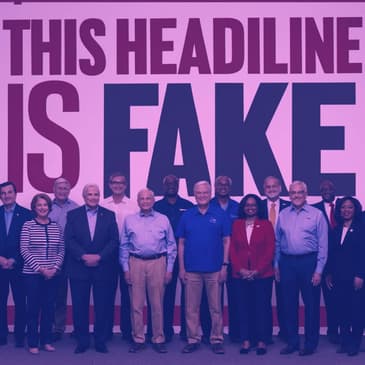
Political campaigns are manipulating news headlines for votes — and how you can do the same for your own ad campaigns for fun and profit. Also: If you haven't figured out your December holiday marketing plans, you might already be too late. Meta closes its AR studio. And did Google just release its internal ad tools to the public?
Visit Our Sponsor: Unerry
📰 Get our free daily newsletter
📈 Advertising: Reach Thousands of Marketing Decision-Makers
🌍 Follow us on social media or contact us
Get these exclusive benefits when you upgrade:
✅ Listen ad-free
✅ Back catalog of 20+ marketing science interviews
✅ Get the show earlier than the free version
✅ “Skip to story” audio chapters
✅ Member-only monthly livestreams with Tod
And a lot more! Check it out: todayindigital.com/premium
✨ Premium tools: Update Credit Card • Cancel
MORE
🆘 Need help with your social media? Check us out: engageQ digital
📞 Need marketing advice? Leave us a voicemail and we’ll get an expert to help you free!
UPGRADE YOUR SKILLS
Google Ads for Beginners with Jyll Saskin Gales
Inside Google Ads: Advanced with Jyll Saskin Gales
Foxwell Slack Group and Courses
Today in Digital Marketing is hosted by Tod Maffin and produced by engageQ digital on the traditional territories of the Snuneymuxw First Nation on Vancouver Island, Canada.
Some links in these show notes may provide affiliate revenue to us.
Privacy & Opt-Out: https://redcircle.com/privacy
[00:00:01] It is Wednesday, August 28th. Today, political campaigns are manipulating news headlines for
[00:00:07] votes, how you can do the same for your own ad campaigns for fun and profit.
[00:00:13] TikTok says if you haven't figured out your December holiday marketing plans by now,
[00:00:17] you may already be too late. Meta closes its AR studio suddenly. And did Google just
[00:00:24] release its internal ad tools to the public? I'm Tod Maffin. That's a head today in
[00:00:32] digital marketing. Well, you probably won't be surprised to hear that US presidential
[00:00:37] campaigns are spending millions of dollars on Google ads right now, but you might be
[00:00:42] surprised to learn that they're running ads to articles written by major news organizations
[00:00:48] like NPR, Time and The Guardian. And they are changing the headlines of those articles
[00:00:55] without permission from the news organizations. How is this possible? Turns out it's allowed,
[00:01:01] even by Google's strict political advertising policies. Here to tell us more is our Google
[00:01:07] ads correspondent Jill Sastin-Gales. Hello Jill. Hello, Tod. So how this is the Harris
[00:01:12] campaign that's doing this. How can they be running ads to a website that's not their own?
[00:01:18] First of all, actually anybody can do this. The final URL in your own ad does not need
[00:01:24] to be your domain. Since advertiser verification came into Google ads, we're able to go in and
[00:01:30] see who actually paid for an ad. And of course this has much more use to a political campaign
[00:01:36] trying to borrow the legitimacy of news organizations than say an e-commerce store trying to drive
[00:01:41] traffic, I don't know, to a different e-commerce store. But anyone can do this. It's always
[00:01:45] been allowed. And what came to light is that the Harris campaign is doing this. I'm sure
[00:01:50] the Trump campaign is doing this as well, where just like any ad you put in the final URL of
[00:01:55] where you want people to go. In this case sometimes it's Kamala's website and in this
[00:01:59] case sometimes it's news organizations. And then you write your headlines and descriptions
[00:02:03] for your ad as normal. It reminds me of the good old days when you could do that
[00:02:08] on organic posts. You could just basically take any news story and put it in, this
[00:02:13] is on Facebook, paste it as an embed, go in, change the headline and met it cracked
[00:02:17] down on that pretty quick. You had to prove that you owned that domain and still to this
[00:02:21] day an organic post on Facebook, you've got to verify that you own that domain if you
[00:02:26] want to change the metadata in the embed. You'd think Google would be doing that too.
[00:02:30] Yeah, because in this case it's not like it's the metadata that you're seeing in
[00:02:34] your feed and article with a different headline, it's an ad. And when we write ads
[00:02:38] we get to write headlines. Like if I'm advertising a shirt that's called Todd's fabulous
[00:02:44] fitted blue shirt, I don't know on my website. Maybe I don't want my headline to
[00:02:48] say that because people will know what that means. It might just say best price
[00:02:52] blue shirt on my headline and then you click on it and land on a page with
[00:02:55] something else. That's what we're doing here. But news organizations were taken
[00:03:00] by surprise. Like just one example here it's pointed to an article by the
[00:03:04] Independent which is newspaper in the UK and the headline that the Harris
[00:03:08] campaign is advertising is VP Harris protects democracy. Trump defends Gen 6
[00:03:14] comments. So we don't know because we didn't see this at what actually article
[00:03:18] it led to but it's unlikely that that's what the journalist who wrote that
[00:03:22] article called it or similarly there's one from AP News, the headline that the
[00:03:27] ad manager wrote is VP Harris's economic vision lower costs and higher wages.
[00:03:32] Now if you click that ad and go to that news article it can say whatever.
[00:03:37] And honestly I think it's pretty creative of the ad managers.
[00:03:42] You can see it from a branding point of view. You're absolutely right.
[00:03:45] I think you know if you've got any commerce site and maybe it's a
[00:03:47] cheapy commerce site and it renders titles on the page stupidly.
[00:03:51] Right. And you want to be able to fix that. You can fix that.
[00:03:53] Does it not surprise you though that there's not that Google hasn't carved
[00:03:56] out a policy just for political ads to prevent this kind of stuff?
[00:04:01] Because let's face it by any standard this is misleading.
[00:04:05] Well I will say that when the Harris campaign for example is paying for this
[00:04:10] in addition to things sponsored like all ads do it does say paid for by Harris
[00:04:16] for president. So it will say that on the search engine results page before
[00:04:19] someone clicks. Is it misleading maybe but Google takes the stuff really
[00:04:25] seriously and so the fact that they're allowing it and allowing any
[00:04:29] political campaign to do this means that not misleading enough to cause concern.
[00:04:36] And so as users we can go into the Google ads library and with political
[00:04:41] ads you can actually see how many times the ad was shown and how much was
[00:04:45] spent on it. So the Google ads library you can look up any ads that
[00:04:49] anybody's running and see their text image and video ads but you can't
[00:04:52] see data about them. For political ads though you can and that
[00:04:56] transparency is supposed to help preserve a sense of I don't know honesty
[00:05:01] sticking more to the facts because anyone can go look up and see this stuff
[00:05:05] just as we are right now. So for one AP headline Harris for president spent
[00:05:10] 20 to 25 K on that one ad in the month of August and it was shown about
[00:05:14] 40,000 times for example. And do we know and do we know how much
[00:05:17] money was spent overall on that ad. Can we get that granular in the
[00:05:23] ads library. Yeah. So for each specific ad you can see how many times it was
[00:05:27] shown when it was shown maybe it was only shown for a week or a month and
[00:05:32] how much was spent on it and you can sort by the amount spent by number of
[00:05:36] times seen there really is a lot of transparent data given here about
[00:05:39] political ads that is not even given about other types of ads. You can
[00:05:44] also see if there are certain criteria that were used for the ads. So if
[00:05:48] they included any age criteria gender criteria so only show this to men
[00:05:52] or only show this to women and then location criteria so you can see them
[00:05:56] getting quite geo targeted with these different messages that they're trying
[00:06:00] to get out in different places in the electorate. It's really quite creative
[00:06:04] to be honest. I feel that people forget about the the incredible databases
[00:06:09] that are these ads libraries Google of course has one which we're talking
[00:06:12] about meta has one tick tock has one all the major platforms do. Can
[00:06:16] you walk us through Google's just briefly before we wrap up in terms
[00:06:19] of non political campaigns if someone wanted to look up their competitor
[00:06:24] then what data can we see. Can we see how much money they're spending.
[00:06:28] Can we see what the demographics are. You can't see what they're
[00:06:31] spending or what the demographics are but you can see all of their ads
[00:06:34] even ones that aren't actually running right now. So Google was
[00:06:37] latest to the party with this ads library thing met as has been around
[00:06:41] for years but Google's is I want to say only about two years old or
[00:06:44] so it's called the ads transparency center and when you go there
[00:06:49] my advice is to look up companies not by the company name but by the
[00:06:52] domain being advertised it's much easier to ensure you're finding
[00:06:55] the right advertiser out of the millions of verified advertisers.
[00:06:59] And then when you click on that advertiser you can view all their
[00:07:02] text image or video ads you can sort by date range and then you
[00:07:06] can see if there's different variations and what the ads look
[00:07:09] like so through that through the language you're seeing or the
[00:07:11] image you're seeing you can kind of infer what's going on behind
[00:07:14] the scenes and start in terms of keywords or targeting or budget
[00:07:18] but that isn't made explicitly clear it only is for political
[00:07:22] ads. Interesting. All right. Thank you so much Jill.
[00:07:25] Thank you. Jill's asking Gales is our Google ads correspondent.
[00:07:28] She's here every second Wednesday. You can learn more about her
[00:07:31] Google ads training program at our affiliate link at today in
[00:07:34] digital.com slash GA and you can watch our full unedited
[00:07:39] interview. There is a link to it in today's newsletter which you
[00:07:42] can sign up to for free by tapping the link at the top of
[00:07:44] the show notes. Turning to some other Google news now the
[00:07:51] company is getting ready for the holiday shopping season with
[00:07:53] some new updates for businesses using merchant center.
[00:07:57] First there are some new product trend insights inside
[00:08:00] Merchant Center. These will highlight major shopping search
[00:08:03] and purchase trends in the app. This could help you plan your
[00:08:07] ad campaigns around what's popular at any given time.
[00:08:10] So for example a Denim retailer can see if a specific
[00:08:13] type of shorts is trending and adjust their inventory
[00:08:17] accordingly. Google is also bringing more AI elements into
[00:08:20] its merchant center analytics. The new summaries give insight
[00:08:23] into the products that are gaining the most traction at any
[00:08:26] given time and conversational queries will let you ask for
[00:08:30] custom data sets like the performance of your best selling
[00:08:34] dresses. The company is also improving its product
[00:08:37] availability notes on listing and launching new customer
[00:08:41] acquisition goals in performance Macs and search campaigns.
[00:08:49] Tiktok just dropped a new guide to help businesses plan
[00:08:52] their holiday marketing. The 18 page document is packed
[00:08:55] with data and tips on how to reach users. It is specific
[00:08:58] to the European market though. But Tiktok says its users
[00:09:02] around the world start thinking about holiday shopping
[00:09:05] earlier than you might think they do. Last year users
[00:09:08] began searching for Christmas related content in August.
[00:09:12] The guide breaks down when people are most active and
[00:09:15] what they're searching for. It also reveals what gifts
[00:09:18] are trending this season. Tiktok says its users are
[00:09:21] looking for experiences like travel and concerts as well as
[00:09:25] tech gadgets and sustainable products. Tiktok's guide
[00:09:28] covers the Q5 season that's the period after Christmas
[00:09:32] when shoppers hunt for bargains. This is usually
[00:09:34] when many brands offer discounts and promotions.
[00:09:37] And with only 118 days until Christmas, many brands
[00:09:41] are already finalizing their holiday marketing plans.
[00:09:45] We have a link to the full PDF guide in today's
[00:09:47] email newsletter which you can sign up to for free
[00:09:49] by tapping the link at the top of the show notes
[00:09:51] or going to todayindigital.com slash newsletter.
[00:09:58] Instagram just updated its app with new features to help
[00:10:01] you get a little more creative with your brand's organic
[00:10:03] posts. First it added several new fonts that can be
[00:10:07] used in reels and stories. The app also made it easier
[00:10:10] to add text to posts and mix and match font styles.
[00:10:14] You can now also add stickers to photos and
[00:10:16] carousel posts which was recently updated to
[00:10:18] include 20 frames until now those were limited to
[00:10:21] stories. The updates also include more music features
[00:10:24] which could attract users who might be leaving
[00:10:27] Tiktok. Indeed the new features may be a response
[00:10:30] to Tiktok's popularity and with Tiktok's future in
[00:10:34] the US uncertain, Instagram is racing to position
[00:10:37] itself as an alternative platform for creators.
[00:10:44] Meta is closing its Spark AR Studio platform
[00:10:48] which allowed brands to create augmented reality
[00:10:51] effects for Facebook and Instagram. The platform
[00:10:53] will shut down on January 14th next year. The
[00:10:57] move will impact hundreds of thousands of creators
[00:10:59] who've used Spark AR to develop effects and
[00:11:02] worse any AR campaigns that were built using
[00:11:06] Spark will be disabled after the shutdown date.
[00:11:10] So why is Meta doing this? It says it's shifting
[00:11:12] resources to new experiences like its AR glasses
[00:11:15] but the decision seems counter-intuitive as
[00:11:19] competing platforms like Snapchat have seen
[00:11:21] success with their own AR creation platforms.
[00:11:25] As for what's next, Meta may be developing new
[00:11:27] AR creation tools that use generative AI but the
[00:11:30] company hasn't revealed any details of a
[00:11:33] potential replacement platform leaving many
[00:11:35] creators uncertain about their future. More
[00:11:38] information might be announced at Meta's
[00:11:40] Connect conference next month.
[00:11:47] Can you do this? You're in the morning of
[00:11:49] the day.
[00:12:14] Hi, I'm Sean Nelson, founder and CEO of LoveSack
[00:12:18] and host of the Let Me Save You 25 Years podcast.
[00:12:21] Imagine learning from the best without the years
[00:12:22] of struggle. On my podcast, I sit down with
[00:12:25] stars like Montell Jordan and Sarah Blakely to
[00:12:28] share the hard-earned lessons that can save
[00:12:29] you time and effort on your path to success.
[00:12:32] Ready to speed up your success story? Listen
[00:12:35] to Let Me Save You 25 Years with Sean Nelson
[00:12:37] wherever you get your podcasts.
[00:12:39] Google faced a lot of criticism in February.
[00:12:42] Its AI chatbot Gemini couldn't create images
[00:12:45] of white people in historical contexts.
[00:12:47] To stop the backlash, Google opted for the
[00:12:50] nuclear option and just disabled the ability
[00:12:52] to render humans at all.
[00:12:55] Now Google is turning that feature back on
[00:12:58] but only for users who pay for Gemini advanced.
[00:13:01] Google has struggled with its AI products.
[00:13:04] The company's chatbot Bard got a major
[00:13:06] fact wrong in its public outing.
[00:13:08] Critics called Google's AI racist and sexist.
[00:13:12] The company says like all AI, its technology
[00:13:14] will still make errors and at least for the
[00:13:17] time being it still won't respond to
[00:13:19] requests for photorealistic images of
[00:13:21] public figures, minors or violent imagery.
[00:13:29] And finally today many media buyers and
[00:13:31] marketers noticed a new option in Google
[00:13:33] ads but they might have been scared to
[00:13:35] click it. Down the main menu column
[00:13:37] appeared a button reading internal tools.
[00:13:41] The brave ones who did click it found
[00:13:43] that opened up a submenu with the
[00:13:45] option audience builder in it.
[00:13:47] Now audience builder isn't new but the
[00:13:49] whole internal tools thing was a
[00:13:52] deadline Google had not addressed the
[00:13:54] issue but it is believed to just be a glitch.
[00:13:59] All right I have to practice for an
[00:14:00] Elder Scrolls trial with my guild.
[00:14:03] Yeah I'm that guy now apparently so I
[00:14:05] got to go. Thanks for listening.
[00:14:06] See you tomorrow.
[00:14:09] Are you an ad agency with clients in
[00:14:11] the retail sector or a retail store
[00:14:14] or brand that wants to improve your
[00:14:16] understanding of your customers?
[00:14:17] Well you're in luck.
[00:14:19] This summer Unnery has started offering
[00:14:21] retail shopper dashboards for clients
[00:14:23] in the United States and Canada.
[00:14:25] Great for brands retailers and
[00:14:28] marketing agencies to be able to
[00:14:29] visualize customer visits to their
[00:14:32] own stores and to selected
[00:14:34] competitor stores as well.
[00:14:36] This new service is useful for
[00:14:38] identifying growth of competitors
[00:14:40] and consumer brand preferences from
[00:14:42] customers foot traffic.
[00:14:44] Contact the Unnery team that's
[00:14:48] Unnery by clicking the link in
[00:14:50] this episode's show notes.