
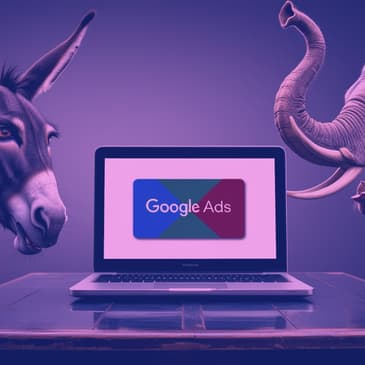
We marketers make a lot of assumptions about people. That conservatives like big show’ey patriotism like flags and anthems. And progressives like anything to do with the environment. There. Problem solved. Now you have your creative.
But what if we’re missing a huge piece of this puzzle — user behaviour. How people of different political leanings interact with the marketing tools that get us the sale.
One of the biggest tools, of course, is search ads. Is it possible that conservative buyers and liberal buyers think of, and use, our Google ads differently?
Today, Tod speaks with Dr. Alex Davidson, author of a research paper published this month in the Journal of Advertising called “How Political Orientation Affects Trust in Search Advertising.”
Link to the study: https://www.tandfonline.com/eprint/YUZWNJZSZKPBITQ5MFGF/full?target=10.1080/00913367.2024.2393708
.
📰 Get our free daily newsletter
📈 Advertising: Reach Thousands of Marketing Decision-Makers
🌍 Follow us on social media or contact us
.
Get these exclusive benefits when you upgrade:
✅ Listen ad-free
✅ Back catalog of 20+ marketing science interviews
✅ Get the show earlier than the free version
✅ “Skip to story” audio chapters
✅ Member-only monthly livestreams with Tod
And a lot more! Check it out: todayindigital.com/premium
✨ Premium tools: Update Credit Card • Cancel
.
MORE
🆘 Need help with your social media? Check us out: engageQ digital
.
UPGRADE YOUR SKILLS
Google Ads for Beginners with Jyll Saskin Gales
Inside Google Ads: Advanced with Jyll Saskin Gales
Foxwell Slack Group and Courses
.
Today in Digital Marketing is hosted by Tod Maffin and produced by engageQ digital on the traditional territories of the Snuneymuxw First Nation on Vancouver Island, Canada. Associate producer: Steph Gunn.
Some links in these show notes may provide affiliate revenue to us.
Privacy & Opt-Out: https://redcircle.com/privacy
[00:00:00] It is Monday, September 30th. I'm Tod Maffin. Here in Canada, it is the National Day for Truth
[00:00:06] and Reconciliation, which is a stat holiday here, but I know it's probably not a stat where
[00:00:11] you are, so today a special deep dive marketing science episode. We marketers make a lot of
[00:00:18] assumptions about people. The Conservatives like big showy patriotism like flags and anthems
[00:00:24] and progressives like anything to do with the environment. There you go, problems solved.
[00:00:30] Now you have your creative. But what if we're missing a huge piece of this puzzle?
[00:00:35] User behavior. How people of different political leanings interact with the marketing tools
[00:00:41] that get us the sale? One of the biggest tools, of course, is search ads. Is it possible
[00:00:47] the conservative buyers and liberal buyers think of and use our Google ads differently?
[00:00:56] That's what Alex Davidson said out to discover. He's the author of a research paper published
[00:01:00] last month in the journal of advertising called How Political Orientation affects trust in search
[00:01:06] advertising. He's an associate professor of marketing at Wayne State University in Detroit.
[00:01:11] He joins me now from his office in Montreal, Dr. Davidson, welcome. Yes, hi, Tod. Thank you for
[00:01:17] you. So is this true? Does the way people think politically have a bearing on how they use search ads?
[00:01:23] Yeah, that's largely what I found in my research. So what I was studying, what I was interested in,
[00:01:32] is what I define as search ad avoidance. And search ad avoidance is this deliberate or sometimes
[00:01:42] unconscious way that us as online users will avoid or bypass the sponsored advertisements that
[00:01:50] appear in search engine results pages. So you've might have noticed that you've done this sometimes
[00:01:56] where you search for something on Google and even though there's an ad that addresses what you're
[00:02:02] searching for instead, you click on the organic link. You don't want to click on the ad. You might
[00:02:08] have had some friends that have done this. I noticed this when I was searching for a barbecue brush
[00:02:14] not too long ago and then I saw a webpage from Home Depot that was being promoted as an ad. And
[00:02:20] then I saw that exact same webpage in the organic section and I chose the organic one. And so
[00:02:26] I started thinking, what's going on here? Why are we doing this? And there's some research
[00:02:34] indicating that people's trust in advertising affects their willingness to engage with ads.
[00:02:41] And so I started wondering, okay, if people generally have a distrust in advertising,
[00:02:49] is there a way for marketers to identify groups that have higher levels of trust in advertising?
[00:02:53] And so I began to look at people's political orientation. So why is it that political orientation
[00:03:01] would affect the way people react and engage and click on ads? Well, first let's understand what
[00:03:10] political orientation is. So political orientation could be understood as the set of beliefs people
[00:03:17] have about the proper order and governance of society. I would argue that our political orientation
[00:03:24] is largely responsible for our core beliefs and values affecting what we do and don't trust.
[00:03:33] So we've seen increasing polarization over the last few decades and our political orientation
[00:03:40] has come to affect nearly everything we do. You mentioned some of them at the beginning here,
[00:03:46] but it really does affect everything from where we live to what we read and watch,
[00:03:51] to who we're friends with and even who we want to have a relationship with. And in regards
[00:03:55] to the way that we process online information, it became clear to me that there should be a liberal
[00:04:02] conservative divide in the trust towards sponsored versus organic communications.
[00:04:09] So compared to liberals, conservatives should be more likely to think that advertising plays a
[00:04:15] just role within marketing. And is that because conservatives generally skewed toward
[00:04:22] capitalism and the fair market itself is self-governing and therefore it is the most pure form
[00:04:28] of fairness possible? Yeah, exactly. And this is something that research has shown over and over again,
[00:04:35] conservatives do have more pro business attitudes than liberals where liberals have more pro
[00:04:41] government attitudes than conservatives. This is one of the biggest differences between
[00:04:47] both sides of the political spectrum. And so given that conservatives should consider advertising
[00:04:56] to be more fair and more just, you would assume that they would have higher levels of trust in
[00:05:02] advertising. Now how you can sort of test that and extract that experimentally, that's where I
[00:05:09] started to think about interesting ways we can do that. And so the search engine results page,
[00:05:16] I think is a wonderful way to test this theory because pointing to my earlier example, it often
[00:05:22] presents the same website as a sponsored ad and as an organic link. So you have both options.
[00:05:30] And when presented with both options, I expected for conservatives to be more likely than liberals
[00:05:36] to choose the search ad over the organic link. And that's exactly what I found. Even though
[00:05:41] the ad listings were identical between paid and organic. Yes, exactly. So I ran a few studies.
[00:05:50] In one of them, I looked at actual Google analytics data. And I compared the clicks towards a retail
[00:06:02] website. I looked at the difference between clicks coming from search ads versus organic links.
[00:06:09] So while I wasn't exactly sure how similar the search ad was the organic link,
[00:06:15] I did find that the effect was there, right? That conservatives, more than liberals would click the
[00:06:21] search ad over the organic link. But then I brought that into a more controlled setting where I ran a
[00:06:31] couple of experiments through online surveys. And there I was able to show people a search ad that
[00:06:38] looked the identical as an organic link. And in the experiment, I identified which one is the search ad,
[00:06:46] which one is the organic link? And again, you see the same result manifest. So it seemed pretty
[00:06:54] conclusive to me that conservatives, because of what we refer to as their system just to find tendencies,
[00:07:04] not to get too technical. But because of their willingness to trust the marketplace,
[00:07:13] to perceive market-based activities as more fair and legitimate, they have these higher levels
[00:07:19] of trust and advertising. And that comes through really strongly with in search engine marketing.
[00:07:27] You did four experiments. One was based on polling data of where Americans saw their political
[00:07:33] leanings, and then you matched that up with clicks. But that data came from polls in 2018.
[00:07:39] Now since 2018, a lot has happened in the US. There was January 6, Biden stepped down.
[00:07:45] Two is as an Asian attempt against Donald Trump. How do you think your results would be different
[00:07:51] if you'd used more recent polling data? Do you think there's been a change that much of a shift
[00:07:56] in American politics that it trickles down to the results marketers get? So that's a great question.
[00:08:04] Arguably, you could say that within conservatives or within liberals, liberals,
[00:08:11] you might see shifts over time. Usually, slight shifts, nothing to major. We know
[00:08:19] from research within US politics that by and large conservatives tend to stay
[00:08:27] conservative, liberals tend to stay liberals. And then there's those independence are
[00:08:32] undecided in the middle who usually are attracting the attention of politicians. Now
[00:08:37] what's important when conducting the kind of research that I'm looking at is not so much
[00:08:45] whether these shifts occur, but whether in making comparisons between conservatives and liberals,
[00:08:54] we see large differences from one year to the next. And that's where we don't see a lot of
[00:09:02] significant change. If anything, they become more polarized. So conservatives seem to rally
[00:09:10] more strongly around their ideology over time and liberals do the same thing. So in my research,
[00:09:19] based on my theory, if what I'm saying is correct, that conservatives more than liberals
[00:09:25] tend to justify and perceive market-based systems and advertising as more fair, then that shouldn't
[00:09:36] dissipate. That if anything has only become stronger over time. And, you know, as marketers,
[00:09:42] we want people to click on our ads and probably a lot of organizations, brands, companies,
[00:09:48] one of their prime audiences are people who would vote liberal. Did any of your studies suggest ways
[00:09:55] to mitigate ad-invoidance for audiences that are less receptive like progressive liberals,
[00:10:01] so Democrats? So I didn't introduce anything to manipulate people to act differently,
[00:10:11] but what I also found within my research is that the way in consumers search will affect
[00:10:21] how they process information and it will affect, whether or not they click on ads. So let me
[00:10:28] give you an example here. At the beginning of the customer journey, consumers tend to conduct what
[00:10:36] we call broad searches. So if I'm looking for a new laptop and I'm just beginning my customer
[00:10:44] journey, I'll go on to Google and I'll simply type in the word laptop to begin my search.
[00:10:52] Now perhaps a few weeks later after I've done a lot of searching, I've done a lot of thinking
[00:10:58] about this and I'm closer to making a purchase in the later stage of my customer journey.
[00:11:04] I'm more likely to conduct a more specific narrow search and now my search term might look
[00:11:10] something like laptop with 14 inch screen and 10 hour battery. So when we conduct these broader
[00:11:20] searches such as laptop, we tend not to take the search process too seriously at this point.
[00:11:27] It's kind of like we're window shopping. We have this exploratory mindset.
[00:11:33] And because we're not using much of our brain power, the fundamental parts of our personality
[00:11:39] and therefore our core beliefs and values are going to shape how we process information.
[00:11:45] And so I expected that for broad searches specifically, we should find this effect where
[00:11:50] conservatives are more likely to click on search ads than liberals. And that's actually what I
[00:11:55] found. But for these narrow researchers that happen later on in the customer journey,
[00:12:01] we do tend to take the search process more serious. So we are using more brain power that enables
[00:12:07] more flexibility in our thinking. And so in those cases, our core beliefs and values are less
[00:12:13] influential compared to the actual content of the information we're processing. In other words,
[00:12:19] for narrow researchers, the narrow searches, I did not expect to see any differences between
[00:12:24] conservatives and liberals in search ad clicks and I didn't find any. So all this to say
[00:12:30] that offsetting search ad avoidance among more liberal oriented consumers is likely to happen
[00:12:39] ads there further along in the customer journey. Your research focused on the U.S. did you
[00:12:45] give any thought to help people in other countries might behave differently across the political spectrum?
[00:12:50] I absolutely have and I have not conducted any research on that yet, even though I am a Canadian
[00:12:57] that is an area I would like to dip my toes in. But I am also interested in looking at
[00:13:05] differences in consumers, political orientations, in countries and cultures that differ
[00:13:12] from the U.S., where the political spectrum doesn't align with the way it does for Americans.
[00:13:20] So I'm currently at the beginning stages of a research project that's going to explore
[00:13:26] the effects of political orientation on search ads in Japan to see if we see similar effects
[00:13:34] if they materialize in the same way that they do in the U.S., but as of now, I can't answer
[00:13:40] that question just yet. Let me ask you a broad question. Maybe unfair because you didn't study it
[00:13:45] specifically, but what does your gut say in terms of how political polarization will affect
[00:13:51] consumers trust of digital advertising as a whole? There are no unfair questions. So
[00:14:00] everything is acceptable, but it's hard to say exactly how that will affect trust. Right now,
[00:14:09] what we see is a difference in that conservatives are more trusting and they tend to have these
[00:14:16] tendencies to want to for lack of a better word, conserve and preserve the economic market
[00:14:25] and political systems that we currently live in. And so with that, we have seen lots of evidence
[00:14:34] that more liberal oriented people are more oriented towards organic forms of promotion and marketing
[00:14:42] and content. And that seems to be the way the trend has been going for a while and will likely
[00:14:48] continue to go, but there is no guarantees that that will continue indefinitely. And like we've seen
[00:14:56] in the past with the relationship between, for example, political ideology and political party
[00:15:04] preference. Those two have not been consistent over time, right? So not that long ago, the Republican
[00:15:12] party was the party of the more progressive branch of the U.S. electorate. So yeah, things can
[00:15:22] definitely change and there's been no shortage of surprises in the last few years when it comes
[00:15:28] to politics. But I don't expect anything like that to change to, when we talk about trust
[00:15:35] and digital advertising, I don't expect much change in the near future. How can we exploit this
[00:15:43] as marketers? What, what's the bottom line? What should we be doing as marketers to change
[00:15:49] the way we use Google ads or other search engines to take advantage of this knowledge that you're
[00:15:55] bringing us? I think this research highlights an issue that marketers might have not been fully
[00:16:02] aware of and bringing it to light can help them better prepare for their campaigns, for their
[00:16:09] strategies. So for example, if they are targeting more liberal oriented marketplaces and I have ways
[00:16:17] that can be identified in my research, if they are doing that and they're realizing maybe they're
[00:16:25] not getting as high of a click through rate as they like. Perhaps they're not converting in a way
[00:16:31] that they would expect. This research is in place to say, okay, there could be a reason and that
[00:16:38] reason could be that that marketplace simply does not trust your ads as much as your organic links.
[00:16:46] So what can you do in that situation? Well, one idea is don't abandon your SEO strategy.
[00:16:54] Your search engine optimization strategy. Don't take your foot off the pedal. You want to maintain
[00:16:59] and perhaps even enhance your SEO efforts in that particular situation and especially for liberal
[00:17:07] oriented consumers at the beginning stages of their customer journey. Another thing that they might
[00:17:15] want to consider and my research is going to pursue as it continues is the effect of things like
[00:17:21] trust symbols in search ads. So search ads can play a role in impacting the level of trust
[00:17:30] that consumers perceive in them by having information related to ratings, by having information
[00:17:39] related to endorsing the product from a legitimate, recognized individuals or perhaps just having
[00:17:48] trust symbols that say that a certain business has a certain level of accreditation
[00:17:54] or that it's been certified or it has a guarantee by enhancing trust arguably. We should see
[00:18:01] that even among those marketplaces that have more distrust and advertising, hopefully
[00:18:08] marketers can sort of recoup and take advantage and make sure they don't lose out on those
[00:18:14] marketplaces. That is something I'm going to look at in my research and it's something I encourage
[00:18:19] digital marketers to examine as well. Well, your paper is fascinating and I want to thank you for
[00:18:25] taking a moment to share with us. Yeah, thank you so much. This has been great. I really appreciate it.
[00:18:30] Alex Davidson is an associate professor of marketing at Wayne State University in Detroit
[00:18:35] and is the author of Countering Search ad avoidance how political orientation affects trust in search
[00:18:42] advertising. We have a link to his paper in the show notes.