
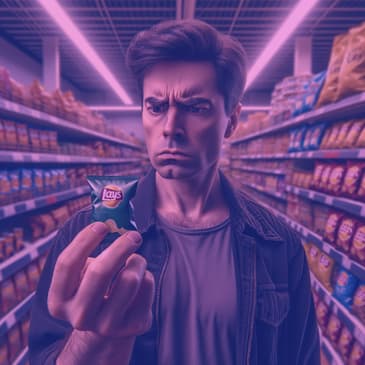
In this special deep-dive episode, Tod speaks with Ioannis Evangelidis, Associate Professor of Marketing at Ramon Llull University in Spain. He recently published a research paper in the Journal of Marketing Science called “Shrinkflation Aversion: When and Why Product Size Decreases Are Seen as More Unfair than Equivalent Price Increases”
📰 Get our free daily newsletter
📈 Advertising: Reach Thousands of Marketing Decision-Makers
🌍 Follow us on social media or contact us
Get these exclusive benefits when you upgrade:
✅ Listen ad-free
✅ Back catalog of 20+ marketing science interviews
✅ Get the show earlier than the free version
✅ “Skip to story” audio chapters
✅ Member-only monthly livestreams with Tod
And a lot more! Check it out: todayindigital.com/premium
✨ Already Premium? Update Credit Card • Cancel
MORE
🆘 Need help with your social media? Check us out: engageQ digital
📞 Need marketing advice? Leave us a voicemail and we’ll get an expert to help you free!
⭐ Review us
UPGRADE YOUR SKILLS
Inside Google Ads with Jyll Saskin Gales
Google Ads for Beginners with Jyll Saskin Gales
Foxwell Slack Group and Courses
Some links in these show notes may provide affiliate revenue to us.
Today in Digital Marketing is hosted by Tod Maffin and produced by engageQ digital on the traditional territories of the Snuneymuxw First Nation on Vancouver Island, Canada.
Privacy & Opt-Out: https://redcircle.com/privacy
[00:00:00] It is Monday, April 8th. Today a special episode about how marketers should approach product pricing in the era of shrink-flation.
[00:00:11] Some new data out and I will speak with a researcher who did this study. First, a tiny apology.
[00:00:16] I accidentally recorded my track with the wrong microphone so I've done my best to correct it in post but it does sound a little muddier than usual.
[00:00:25] Not to worry, your AirPods are not broken. Okay, on with today's show.
[00:00:31] When the global economy took a nosedive, the executives at Schooner Tuna had a problem.
[00:00:37] They already were the most expensive tuna brand, all their previous promotions had failed like the Hawaiian vacation giveaway held during hurricane season.
[00:00:47] So they went for a Hail Mary to temporarily change their prices.
[00:00:53] My fellow Americans, I am Howard Humphrey, president of Schooner Tuna.
[00:00:58] All of us here at Schooner Tuna sympathize with those of you hit so hard by these trying economic times.
[00:01:05] In order to help you, we are reducing the price of Schooner Tuna by 50 cents a can.
[00:01:11] When this crisis is over, we will go back to our regular prices.
[00:01:15] Until then remember, we're all in this together.
[00:01:19] The gambit worked, but you won't find the Schooner Tuna story in any marketing journals or case study sites and that's because it's fictional.
[00:01:27] Part of the plot of the 1983 film Mr. Mom.
[00:01:31] But executives are living that film today, trying to decide how to keep their margins in the face of rising costs.
[00:01:38] There are a number of ways to keep things in balance and one that gets a lot of attention these days is the concept of shrinkflation,
[00:01:44] reducing the size or quantity of a product and hoping consumers don't mind.
[00:01:49] Or better yet, notice.
[00:01:52] But is that the right play?
[00:01:54] Do consumers hate the practice so much they'd actually be willing to pay more for the same size?
[00:01:59] That's what Yanis Ivangelina set out to discover.
[00:02:02] He's an associate professor of marketing at Ramon Lul University in Spain.
[00:02:06] His paper is called Shrinkflation aversion when and why product size decreases are seen as more unfair than equivalent price increases.
[00:02:18] He joins me from his office in Barcelona.
[00:02:20] Dr. Evangelitas, welcome.
[00:02:22] Thank you for having me over.
[00:02:24] Not at all. Thank you.
[00:02:25] So let's get to the obvious key points.
[00:02:27] You had a bunch of example products in your study, potato chips, chocolate bars, orange juice.
[00:02:32] And you asked people if they thought increasing the price was fair or unfair.
[00:02:36] And then you asked if they thought decreasing the size was fair or unfair.
[00:02:41] Which one did your consumers prefer?
[00:02:43] That's right.
[00:02:44] So in all these cases, I told people that the cost for the business have increased.
[00:02:49] So that's an important parameter to keep in mind because the costs need to have increased for people to find either of them acceptable.
[00:02:57] So assuming the cost of the business has increased and indeed for many of them they have,
[00:03:02] people find product size decreases to be more unfair, much more unfair than price increases.
[00:03:09] So most people think that raising the price when the costs go up is perfectly fine, it's fair.
[00:03:14] But at the same time, decreasing the size of the product is really seen as unfair.
[00:03:19] And why unfair?
[00:03:21] I mean, I can only speak for myself whenever I noticed that.
[00:03:24] I noticed it the other day in potato chips as well.
[00:03:26] And the reason that it kind of got under my skin was that it felt like they were trying to sneak it by me.
[00:03:31] Is that the reason people in your study didn't find it fair as well?
[00:03:35] Yeah, that's exactly right.
[00:03:37] Your intuition is right.
[00:03:38] And that was my experience too when I first noticed the phenomenon.
[00:03:41] Indeed, when you ask people to explain why they find unfair,
[00:03:45] the majority, they come up with the fact that, you know, it's deceiving.
[00:03:49] We are less likely to notice a decrease in the size of the product than we are to notice an increase in price.
[00:03:54] So it's less transparent basically to decrease the size of the product than people think.
[00:03:59] The companies basically had to be sneaky and they don't like that.
[00:04:02] You also tested whether disclosing the shrink flation to consumers would make it less palatable.
[00:04:09] I want to read the example that you presented to your study participants.
[00:04:12] This is from your study.
[00:04:13] Production costs for a detergent manufacturer recently increased.
[00:04:17] A few days ago, the manufacturer decreased the net weight of its product from 140 fluid ounces to 118 fluid ounces.
[00:04:26] The price of the product remained the same.
[00:04:29] The firm explicitly communicates the change in the size of its products to consumers on the packaging.
[00:04:38] The packaging states $16 for 118 fluid ounces, previously $16 for 140 fluid ounces.
[00:04:46] So did this disclosure of the shrink flation change what consumers thought of it?
[00:04:52] That's right. Yeah, so people find it much more fair.
[00:04:55] Basically, the vast majority think it's fair to decrease the size of the product once you disclose it.
[00:05:01] And at the same time, they find it equally fair to raising the prices.
[00:05:04] So once you have this transparency, once the firm is upfront with the change, people find it acceptable and fair.
[00:05:10] By a wide margin? By a small margin?
[00:05:12] By a substantial margin, right?
[00:05:14] So in this paper, 65% of the people, I think, roughly, if I remember correctly, found it fair,
[00:05:19] once the company disclosed it to them.
[00:05:21] Whereas before, more than 50% would find it unsure.
[00:05:26] So it is a big change, substantial change actually.
[00:05:34] Don't forget to pack the 5-hour energy.
[00:05:36] It fits great in a pocket or carrier, and the alert feeling will help you arrive ready for anything.
[00:05:41] Now get 20% off when you use code 5HETRAVEL at 5hourenergy.com.
[00:05:47] Expires April 30th. One time use only. Not valid with other discounts.
[00:05:51] Remember visit 5hourenergy.com and use code 5HETRAVEL to save 20%.
[00:05:58] I know you didn't test purchase intent specifically, but do you have a gut feel on how disclosure would affect people's willingness to buy the products?
[00:06:08] Like, you know, I get that your brand reputation might not take this big a hit and consumers might even think you're being a good corporate citizen for disclosing a reduction in size.
[00:06:18] But will they then buy the product at the higher price if that's the route you pick? What does your gut tell you?
[00:06:24] That is a good question. In this paper I also had a furnace.
[00:06:28] My God tells me that if you were to clearly, if you don't disclose, many people would buy because they don't notice.
[00:06:34] So when you decrease the size of the product, people don't notice, they may end up buying.
[00:06:38] At the same time, when they notice, they will probably react and nowadays people actually do talk to each other.
[00:06:44] And they serve the examples. My God telling me that people appreciate transparency.
[00:06:48] So they would actually support a business that's upfront with it.
[00:06:51] And there is academic research showing that, for example, in other domains when the company discloses their cost structures or why they raise the prices or where all the money that they pay goes.
[00:07:02] So disclosing the different cost structures that they're facing, people appreciate it and are more likely to buy the product.
[00:07:08] So I think people value transparency actually and they would probably be positively inclined to buy the product.
[00:07:15] Of course I haven't done it, but that's my God feeling at least.
[00:07:18] There is another way to address increasing costs other than shrink inflation or increasing the price and that's to lower the quality of the goods that make up the product.
[00:07:27] Did your research look into consumer opinion of that?
[00:07:30] Yeah, I'm working on this topic now so it's not published yet.
[00:07:34] And indeed you're right, it's called skimpliflation, right? So reducing the quality while keeping the size of the price.
[00:07:40] The same. People find it even more unfair. I can tell you that already.
[00:07:44] So people hate it even more to decrease the quality of the product without like while the price stays the same or the quantity stays the same.
[00:07:53] They find it more unfair even though it's shrink inflation. So they really hate reducing the quality of the product.
[00:07:59] Are there any differences between the types of products?
[00:08:03] So not that much in the sense that people always find reducing the quality of the product.
[00:08:10] For example, the size more unfair than the price and I've tried this in a lot of categories by now.
[00:08:14] So I have in the new paper I'm working on I have tried at least 12 different categories even with like streaming services.
[00:08:20] So you like for example, reduce the quality of Amazon Prime or any other streaming service platform for that matter.
[00:08:27] People really don't like it. And I think part of the reason is that people feel they don't consume the same product anymore once you reduce the quality,
[00:08:35] which you can say the same for reducing the price or reducing the size or raising the prices, right?
[00:08:41] Yeah, that makes sense. I mean, the example that I always think of with that is chocolate that, you know, they keep adding fillers into chocolate.
[00:08:48] I don't know whether that's true or not but it sure feels like it sometime, you know.
[00:08:52] Yeah, there are many examples that like instead of for example, you buy an olive spread and they use lower quality oil or you buy chips.
[00:08:59] And instead of like using like red onions, they use like spring onions and chips like there's so many examples out there actually if you look into it was quite fascinating.
[00:09:09] What surprised you the most about your findings?
[00:09:11] To be honest, nothing surprised me because I found like I started worrying on this because I actually experienced myself.
[00:09:17] I thought it's nikkia and I'm like there must be other people clearly who think the same.
[00:09:21] So I don't think something surprised me particularly about it.
[00:09:25] Perhaps what surprised me is now working on the topic of skimflation.
[00:09:28] I didn't have strong priors or that people would hate it more to reduce the quality than to reduce the size.
[00:09:35] So that's a bit more surprising to me that people really dislike reducing the quality because they are like well, it's not the same product anymore.
[00:09:42] That to me was perhaps less intuitive than actually comparing shrink flation to raising prices.
[00:09:48] Alright, so bottom line. We know consumers hate it when brands try to sneak a size change past them.
[00:09:54] So what should marketers do then? Should we increase the price or decrease the size but disclose it on the packaging?
[00:10:02] So honestly my study show that's kind of the same if you disclose the shrink flation.
[00:10:08] It's kind of the same as raising the prices.
[00:10:10] My take is that firms should be honest and if you don't want to disclose it just raise the prices.
[00:10:16] Raising the prices is seen as the most fair practice in most cases.
[00:10:20] And to be honest with you, it's also less costly for the firm because if you reduce the size of the product
[00:10:26] it means you need to actually change the packaging or if you don't change the packaging
[00:10:30] you at least change somehow the production a bit and it's more wasteful.
[00:10:33] Like maybe if you keep the same bag of chips and you pull a few chips on it's like even more like why you don't need to do that just raise the price.
[00:10:40] Well, it is very interesting research. I'm delighted that you were able to share it with us. Thank you for your time.
[00:10:45] Yeah, thank you for inviting me.
[00:10:47] Yanis Ivangelidis is the author of a research paper called Shrinkflation aversion
[00:10:52] when and why product size decreases are seen as more unfair than equivalent price increases.
[00:10:59] It was published in the Journal of Marketing Science.
[00:11:03] Shrinkflation.com