
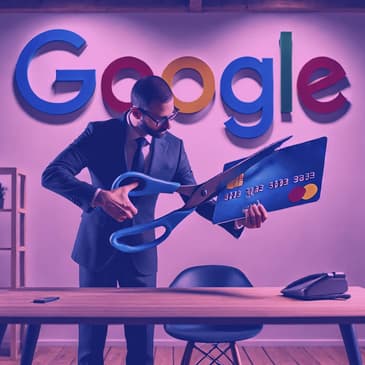
Google won't let some companies pay for ads by credit cards any more, in a move that could cost businesses hundreds of thousands of dollars overnight. Also: A dispute between two big ad players could shake up video inventory. Threads releases its API and makes it free. And YouTube's plans to let regular people add corrections to your brand's videos — what could possibly go wrong?!
Contact Us • Links to today’s stories
📰 Get our free daily newsletter
📈 Advertising: Reach Thousands of Marketing Decision-Makers
🌍 Follow us on social media or contact us
Get these exclusive benefits when you upgrade:
✅ Listen ad-free
✅ Back catalog of 20+ marketing science interviews
✅ Get the show earlier than the free version
✅ “Skip to story” audio chapters
✅ Member-only monthly livestreams with Tod
And a lot more! Check it out: todayindigital.com/premium
✨ Premium tools: Update Credit Card • Cancel
MORE
🆘 Need help with your social media? Check us out: engageQ digital
📞 Need marketing advice? Leave us a voicemail and we’ll get an expert to help you free!
⭐ Review us
UPGRADE YOUR SKILLS
Google Ads for Beginners with Jyll Saskin Gales
Inside Google Ads: Advanced with Jyll Saskin Gales
Foxwell Slack Group and Courses
Today in Digital Marketing is hosted by Tod Maffin and produced by engageQ digital on the traditional territories of the Snuneymuxw First Nation on Vancouver Island, Canada.
Some links in these show notes may provide affiliate revenue to us.
Privacy & Opt-Out: https://redcircle.com/privacy
[00:00:00] It is Tuesday June 18th. Today Google won't let some companies pay for ads by credit card anymore in a move that could cost businesses hundreds of thousands of dollars overnight. Also a big dispute between two big ad players could shake up video inventory.
[00:00:19] Threads releases its API and makes it free. And YouTube's plans to let regular people add corrections to your brand's videos. What could possibly go wrong? I'm Tod Maffin, that's ahead today in Digital Marketing.
[00:00:39] Google is eliminating the ability for some ad accounts to pay using a credit card and some companies say that could add hundreds of thousands of dollars to their bill. Google last week sent an email to some advertisers saying their credit cards would
[00:00:54] be accepted as payment at the end of next month and they'll need to set up a bank transfer or hilariously mail a paper check. In the email, Google said that accounts that don't do this in time will have their
[00:01:08] ad account suspended adding quote, there are no exceptions unquote. The email goes on to say this impacts what Google calls high growth customers. Nikki Kuhlman, director of search strategy at Jumpfly posted quote, it says high growth
[00:01:23] customers yet I have two small clients who spend around under $5,000 a month that got this email. They aren't high growth in any way unquote. On Reddit there are countless comments along the same lines. One reads quote, I got like 20 of these emails today followed by clients asking
[00:01:41] WTF is this about? Our clients spend $400 to $1,000 per month unquote. So why is Google doing this? That depends on who you ask. Jenny Marvin, Google's ad liaison said it was quote, to deliver a more consistent billing experience across our advertisers unquote and said only a small number of
[00:02:03] advertisers were affected. We asked how many small is and did not get a reply back by deadline. It's also not clear how this move would make anything more consistent. Some speculate this isn't any more complicated than Google just trying to claw back the
[00:02:18] money that would have gone to credit card fees. A Google ad buyer named Manakamani posted on social quote, seems like Google might save $2,500 for every $100,000 in ad spend but piss off their best customers along the way. I never expected this from a company of their size.
[00:02:35] Like I expect a local coffee shop to say they don't accept credit cards. But not Google unquote. This could cost advertisers a lot. One finance company founder said the change would cost them a quarter of a million dollars per year.
[00:02:50] Another entrepreneur, Eric Mitz posted quote, it will cost us an extra $200,000 per year overnight. Plus it will basically destroy the standing we have with our credit card company and reps there affecting other parts of our business as well unquote.
[00:03:06] But maybe there's a bright side as one person asked on social media, quote, so we are getting 2.5% off on ad spend right unquote. There was no reply. The US government yesterday filed a lawsuit against Adobe accusing it of deceiving
[00:03:26] customers by making it difficult to cancel subscriptions to its popular design software including Photoshop. The lawsuit said Adobe concealed expensive cancellation fees and designed a complex cancellation process to deter customers from terminating their contracts. That early termination fee, which can sometimes be hundreds of dollars was the government
[00:03:46] says buried in fine print and behind small text links that nobody really clicked. It says the company's website and customer service reps made canceling subscriptions even more challenging, dropping calls, transferring between reps and so on.
[00:04:02] If proven in court, these practices would violate an Obama era law called the restore online shoppers confidence act. The lawsuit is asking for compensation for affected consumers, civil fines and a permanent injunction to prevent future violations.
[00:04:18] For its part, Adobe says it's subscription services are quote convenient, flexible and cost effective unquote and that it is quote transparent with the terms and conditions of our subscription agreements and have a simple cancellation process unquote. We made about $14 billion in revenue from subscriptions last year.
[00:04:38] In 2019, that number was about half that amount. Media buyers who deal in programmatic ads are watching a dispute between the trade desk and Yahoo very closely with the deadline to resolve the spat having been passed just hours ago.
[00:04:57] The trade desk is one of the largest demand side platforms and it recently accused of misclassifying its video inventory as in stream, a type of online video that typically fetches higher prices from buyers. They say if Yahoo doesn't fix this, they will cut off access to Yahoo's video
[00:05:15] inventory. That deadline passed last night. If they go through with their threat, that would remove access to Yahoo's video inventory across open market and library deals immediately and all Yahoo video inventory, including one to one private marketplace deals by the end of next month.
[00:05:32] There's been radio silence so far today. So for all we know, the negotiations are still ongoing. Yahoo says it's trying to work within the trade desk's video inventory standards, but claims the solutions it has tested haven't performed well.
[00:05:49] Meta's social media app Threads might be about to break even more into the mainstream. The company has launched a full service API which will let apps and tools publish content, set reply and quote controls, retrieve replies to their posts, hide, unhide or respond to specific replies.
[00:06:08] The API has been in testing with some of the larger third party platforms like Hootsuite, Sprinkler and Sprout Social. Notably, the API is free to use going against the recent trend by X and Reddit to lock its back end tools behind a paywall.
[00:06:22] This could very well mean that alternate Threads apps will become available. This would be a significant shift from Meta's policies in the past. The company vigorously goes after any third party Facebook or Instagram apps that try to access those services.
[00:06:36] Twitter once had a thriving ecosystem of third party apps like Twitterific and Tweetbot. Most of those were forced out of operation when Elon Musk bought Twitter and locked down its API. Reddit later copied this strategy as well.
[00:06:50] Meanwhile, the two biggest alternatives to X other than Threads, Mastodon and Blue Sky both welcome third party apps. We have yet to see if Meta will allow other people to develop Threads apps, but if they do, it would certainly be a benefit to consumers.
[00:07:06] One thing that is unclear how ads would show up in any third party app. One of the benefits to the now closed third party X and Reddit apps was that the API didn't feed ads through the stream. This, of course, limits the reach of ad campaigns for marketers,
[00:07:23] but it was great for consumers. So what could we see? Well, now that Threads has an API, any number of things become possible, including a more direct connection with the Fediverse. Right now, Threads has a sort of one way connection that works for post
[00:07:36] content, but not really for replies. We might also see a much more robust analytics platform emerge than Threads own somewhat anemic analytics offerings. From the what could go wrong category comes news that YouTube is working on a way for viewers to add corrections to your brand's videos,
[00:07:59] similar to how other social platforms provide community sourced context notes. Quoting social media today, quote, if a note is considered helpful, you might see it pop up in a small box beneath the video. YouTube says only a limited number of eligible contributors can write notes
[00:08:14] for now, while third party evaluators will rate the helpfulness of notes. YouTube will then use this feedback to train its note evaluation system over the coming weeks and months. As the pilot progresses, YouTube will eventually start asking viewers whether
[00:08:29] they consider a note helpful, somewhat helpful or unhelpful and to explain why. It will then feed these responses into its algorithm, which will determine whether a note is broadly helpful. YouTube says it's system is more likely to display a note if many people
[00:08:44] who previously rated notes differently now rate the same note as helpful, unquote. Notes are still in testing, they're only being shown to some mobile users in the US. One potential concern is that notes themselves could be used to spread factually inaccurate information.
[00:09:02] YouTube says anything like that will become, quote, part of how we'll learn from the experiment. It's easy to lose track of the big picture when you have to open a new window for every detail. With Miro, you can bring everything and everyone together in one place,
[00:09:24] consolidate different points of view and increase team collaboration all on one centralized board. We used Miro at our agency to map out a customer journey map for one of our clients and with the help of their huge template library, we were up and running in minutes.
[00:09:40] And the built-in commenting features helped us tweak it without a million back and forth emails. Find simplicity in your most complex projects with Miro. Your first three Miro boards are free when you sign up today at Miro.com slash podcast.
[00:09:56] That's three free boards at Miro.com slash podcast. At Parker, our purpose is simple. We want to make the world a better place by working more efficiently, by using more sustainable practices, by developing better technologies. We keep moving forward with each new idea, innovation and partnership.
[00:10:21] We're one step closer to fulfilling our purpose every single day. To find out more, visit Parker.com slash purpose. Parker, engineering your success. And finally score one for the humans. McDonald's says it's removing AI from its drive-throughs and would
[00:10:39] really like us all to pretend it never really happened. You might have seen the TikTok videos of people driving up and having to give their order to an effusive but aggressively unhelpful AI voice. My favorite was the woman who ordered water and some ice cream.
[00:10:55] So the AI added four ketchup packets and three slabs of butter to her order. Then there was a customer who asked for one Coke, but the AI bought overheard someone in the next lane ordering something and added nine cups of iced tea to her order.
[00:11:11] McDonald's says it hasn't given up on AI. It's still working on some ideas that might roll out by the end of the year. God help us all. If you are wondering where yesterday's episode went, perhaps you missed the news.
[00:11:27] Mondays are always slow in terms of news and in the summer it's even more so. So during the summer we are foregoing our Monday episodes, most of the time, there's an exception coming which I'll tell you about in a second.
[00:11:39] And any news that happens on Monday we will use in today's episode, in Tuesday's episodes. Of course, if something big breaks, it's really important we will still come up with an episode on Monday.
[00:11:48] And every once in a while on Mondays during the summer will also be in your feed with a marketing science interview. This Monday for instance, an interview with a researcher who has figured out whether disabling comments on your social media posts, on your brand's
[00:12:03] social media posts is worse for your brand reputationally than letting the comments be there even if there are some egregiously negative comments in place. That will be coming to you this Monday. Alright, back for a regular episode tomorrow. Thanks for listening. See you then.